 It was an up and down kind of day. Our first full day in West Virginia’s Potomac Highlands began at a high rocky cliff and finished deep underground in a cavern.
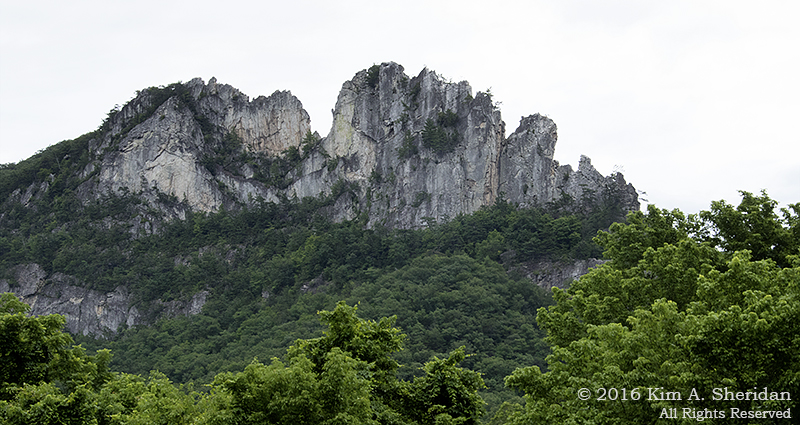
Our first destination? Seneca Rocks, in the Spruce Knob – Seneca Rocks National Recreation Area in Monongahela National Forest. Our goal? To scale the craggy cliffs known as Seneca Rocks.
OK, maybe not. The cliff faces are a popular draw for experienced rock climbers with the technical skill and gear to handle one of the 375 different climbing routes. We were here to ooh and ah over the cliffs from below, and walk the trail to an observation platform just short of the North Peak.
 Don posing in front of Seneca Rocks. Do you think he realizes Robb isn’t pointing the camera at him?
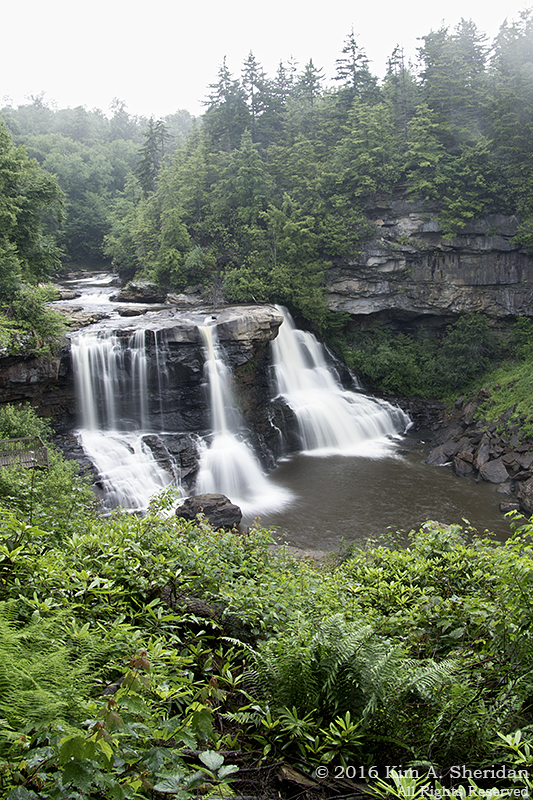
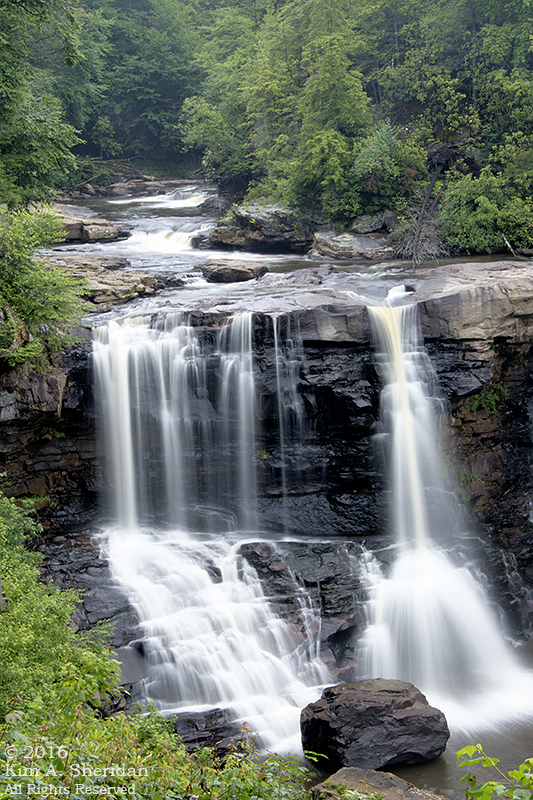
A Geological Diversion: The rocks at Blackwater Falls and many other places in the Potomac Highlands are sandstone, of the Tuscarora Formation. But Seneca Rocks are Tuscarora quartzite. Why?
The sandstones of the area began forming over 500 million years ago. As mountains to the east were slowly eroded away, sand, silt and pebbles washed westward into a shallow sea that covered West Virginia at the time. The sediment settled and compacted into sandstone.
About 275 million years ago, the collision of the continental plates forced the continental crust upward to form the Appalachian Mountains, and sandstone formations like Blackwater Falls were created. In some places, however, extreme pressure and heat caused the sandstone to change into quartzite, a metamorphic rock that is highly resistant to the weathering. Over time, softer stone eroded away to expose the “fin” or razorback ridge of Seneca Rocks.
 In the valley we stopped to admire the Sites Homestead, before crossing Seneca Creek.
 We also crossed the Potomac River. The North Fork of the South Branch of the Potomac River, to be exact.
The trail gains 1000′ elevation in 1.5 miles through a series of steps and switchbacks. That’s pretty stiff. By my calculations, over a 12% grade. What fun!
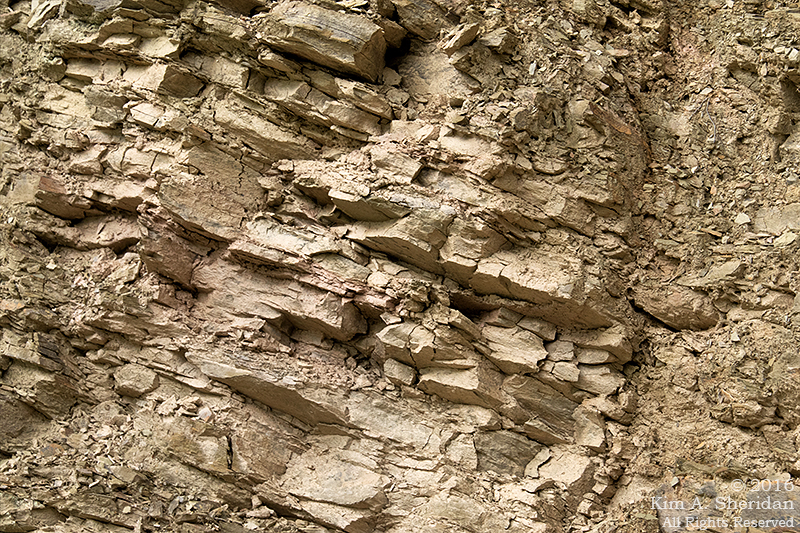 Along the way up we passed a wall of sandstone. No, this photo isn’t crooked. Millions of years of geological uplift have left these layers tilted just so.
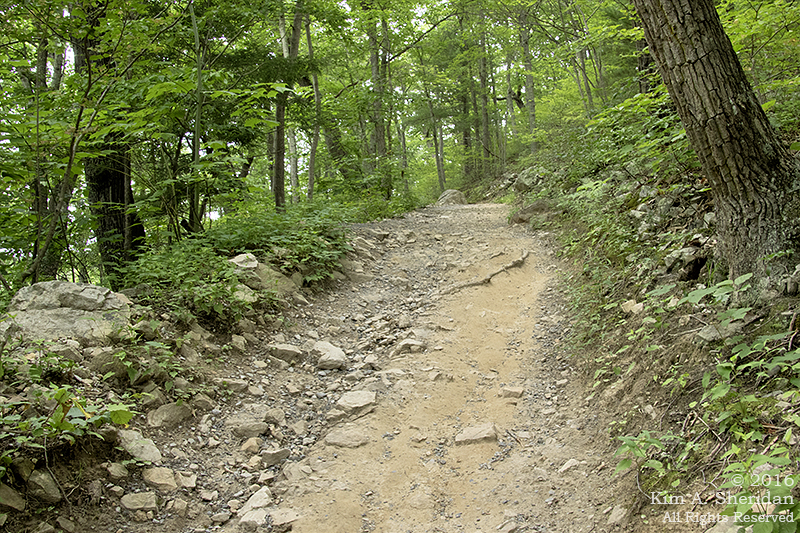 One of many switchbacks. This photo isn’t crooked either, the trees grow that way. Trees like striped maple, birch, beech and oak, and some pines near the summit. I tried to get the entire switchback in the photo, but couldn’t without falling off the mountain.
We heard birds, but didn’t see much wildlife. Perhaps because there were a lot of folks out for a relaxing Sunday stroll. Most of them made it to the top, despite some questionable wardrobe choices. A lot of dogs took the trek, too. Near the start we encountered one little fellow with very short legs that already seemed to be struggling. Darned if he didn’t make it all the way up and back!
 Mushroom. No, the photo isn’t crooked! Plants and rocks alike grow at odd angles on steep mountainsides. Lots of lichens and mosses covered the rocks, and there were ferns everywhere. Wood ferns, sensitive ferns, and – look, Don! Christmas ferns!
 At last! The overlook. I was somehow expecting a close-up view of Seneca Rocks. Instead, the observation platform, perched on the cliff side just below the North Peak, offers a fine view of the valley below and the mountains beyond. Don, front and center.
 While I rest and enjoy a little snack, why don’t you join Don and take in the view.
Wait a minute, where’s Robb?
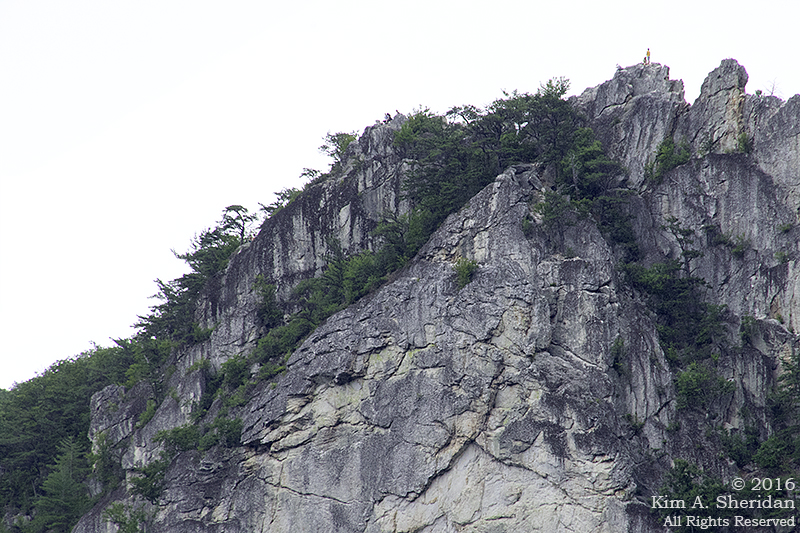 He’s climbed up the rocky trail toward the top of Seneca Rocks, right past the huge STOP! sign warning of death and disaster to all who go past it – which everyone is ignoring. This is the North Peak, accessible without climbing equipment. Just because you can, doesn’t mean you should.
 I want to go to the top, too! But just when I’m rejuvenated, Robb reappears, so we both head out onto the platform to enjoy the wonderful panorama. The pines on the right are Pinus pungens or Table Mountain pine, native to the Appalachian Mountains.
And what’s this? July Fourth weekend, at the top of a mountain; oh, it must be rain. Lovely.
With that, we took our last look over the valley and headed downhill. Fortunately, we were spared a repeat of last year’s Stony Man deluge; the rain this day was light and intermittent. The descent was much easier than the climb, and faster, too. Leaving us with plenty of energy to explore the rocky banks of the Potomac River.
The North Fork of the South Branch of the Potomac River.
 A little way upstream, Seneca Creek flows into the river. Don and Robb decided to continue up the creek bed to the bridge, where I would meet them after retracing my steps along the trail.
Except when I got there, they were nowhere to be found, on the bridge or on the creek. I walked back to the Discovery Center in search of both the guys and a signal for my cell phone, and soon ran into Robb. Who claimed that they were RIGHT THERE on the creek bed, had SEEN me on the bridge, and SHOUTED at me repeatedly to no avail.
But I know I didn’t see them down on the creek. Couldn’t have been that I was looking the wrong way, could it? Nope, not me!
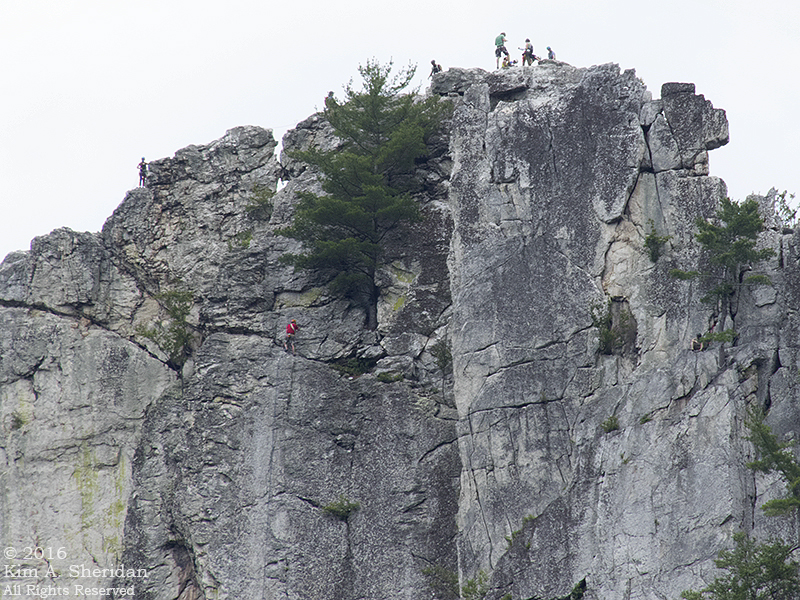 This is the South Peak of Seneca Rocks. Here we find the serious rock climbers doing the serious work of playing on cliff faces. How many climbers do you see? Seven (or more) on the top. Two on the face. Don’t see the second one? He’s at the right edge of the photo, resting in the shade of a tree. Maybe enjoying a good book.
Our plan had been to push on south to Spruce Knob, at 4,863 feet the highest point in West Virginia. When we passed the turnoff for Seneca Caverns, and the sign promised a restaurant, our hunger got the better of us and we changed plans. Happens all the time; besides, it was raining.
 We enjoyed the 45-minute tour through the cavern. It was considerably larger than either of the two Pennsylvania caverns we have been to.
Some of the rooms seemed to soar upward forever.
Then we came to some low, narrow passages that required yoga to weave through.
We never had to wear hard hats in a cavern before, but we were soon grateful for them. The trip leader’s talk was frequently punctuated by a plastic BONK! as one or another of the visitors hit their head on the low ceilings.
We finally emerged from the depths, to more rain and an hour’s drive to our snug cabin in Blackwater Falls.
 To plan for the morrow, and reflect on the highs and lows of a grand day in West Virginia.













 The Wild Edge