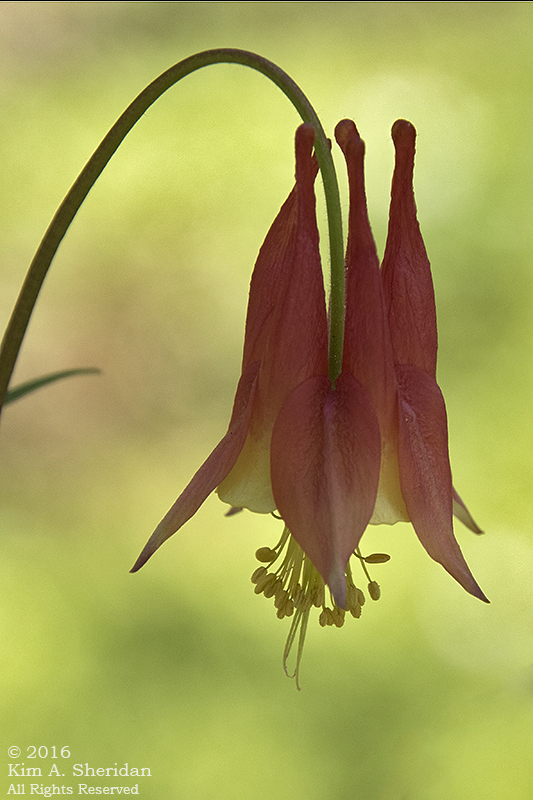
Almost Heaven: After the Rain

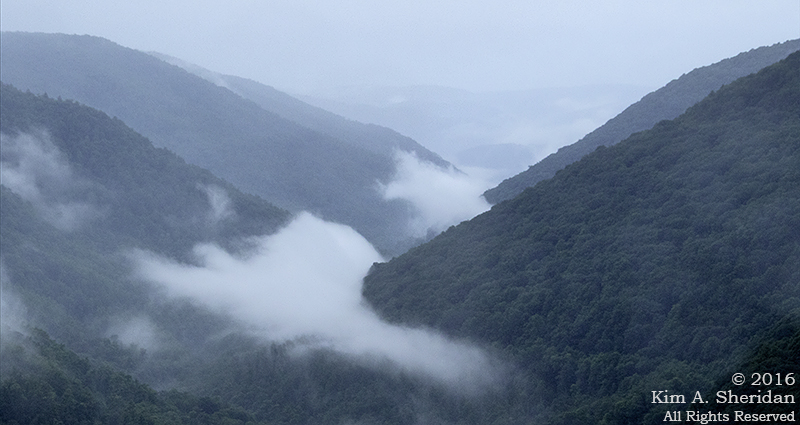
160704_WV Blackwater Lindy Point_2865acsOf all the substances on Earth, water is the most awe-inspiring.

160705_WV Pendleton Lake_3033acsConsider a lake on a misty morning, its surface smooth and still. You dive in, and the water parts, sliding supplely around your skin, its touch as light as silk.  It’s evanescent, nearly intangible. Try to hold it in your hand; it slips away.

Consider a single water drop falling on a stone. Perhaps it rolls off onto the ground; perhaps it remains until the sun melts it away. Yet if water drips relentlessly in the same place for centuries, one single soft drop at a time, the stone will wear away. It doesn’t stand a chance.

Now consider trillions of water drops joined together in a raging river. As it cascades down a steeply inclined bed, the force of the water will eat its way through solid rock. Nothing soft and silky here.

Blackwater Canyon in West Virginia has been sculpted by the Blackwater River for centuries. The sandstone towers and ledges of Blackwater Falls demonstrate the force moving water can have. Nothing quite prepared me for witnessing that power in person, though.

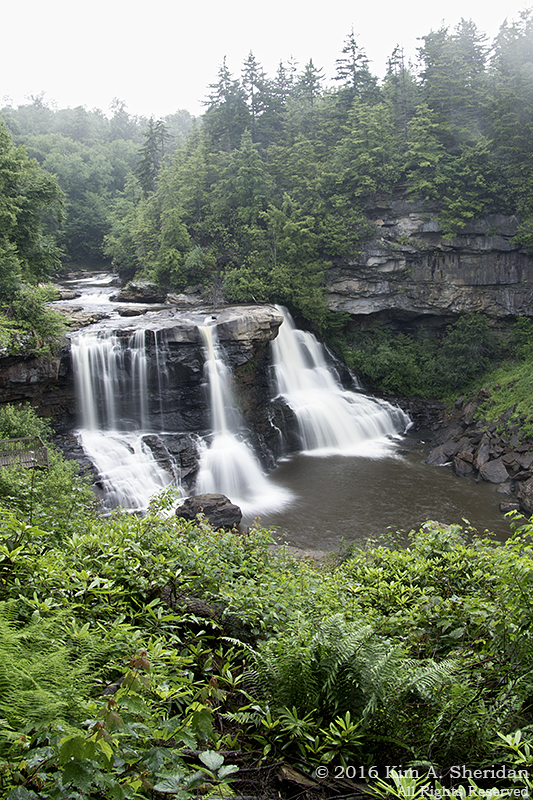
160704_WV Blackwater Falls_2751acsHere is the photo I took of the Falls with its three distinct cascades Monday morning.

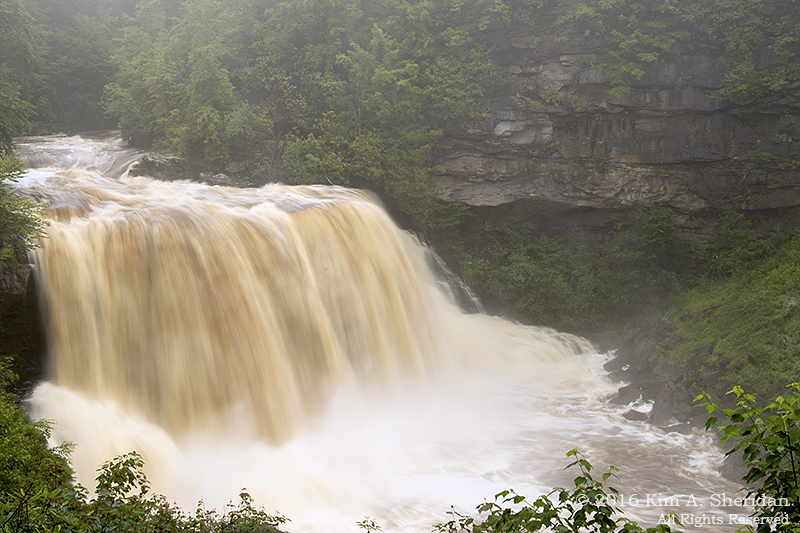
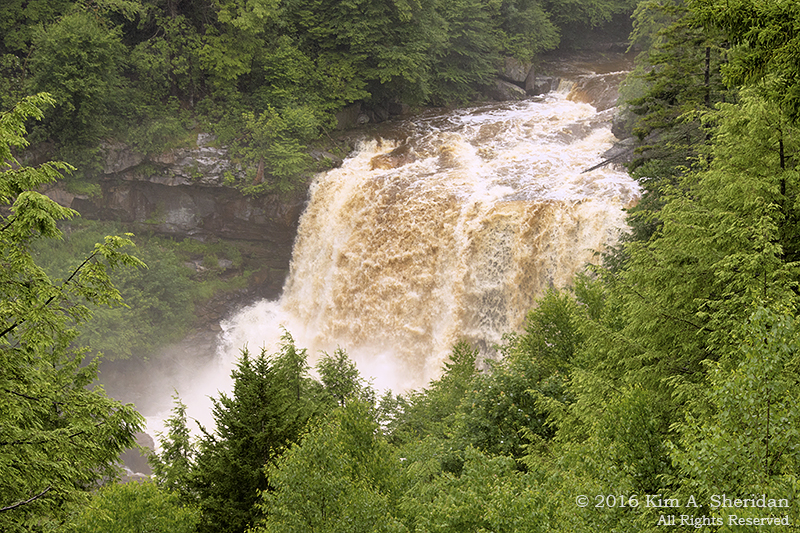
And then, it rained. Overnight the area got quite a soaking. Tuesday morning, Blackwater Falls looked like this:

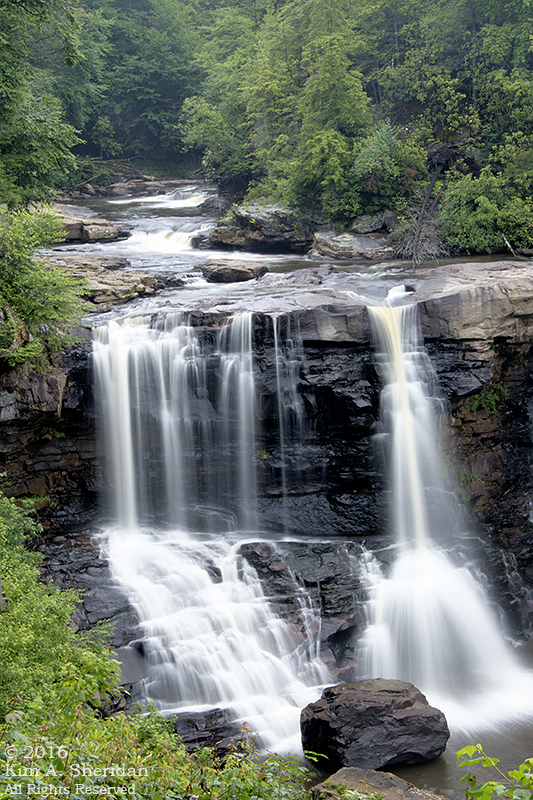
160705_WV Blackwater Falls_3185acsWow. Just, WOW. So much water was pouring over the falls that the sandstone ledges weren’t even visible.

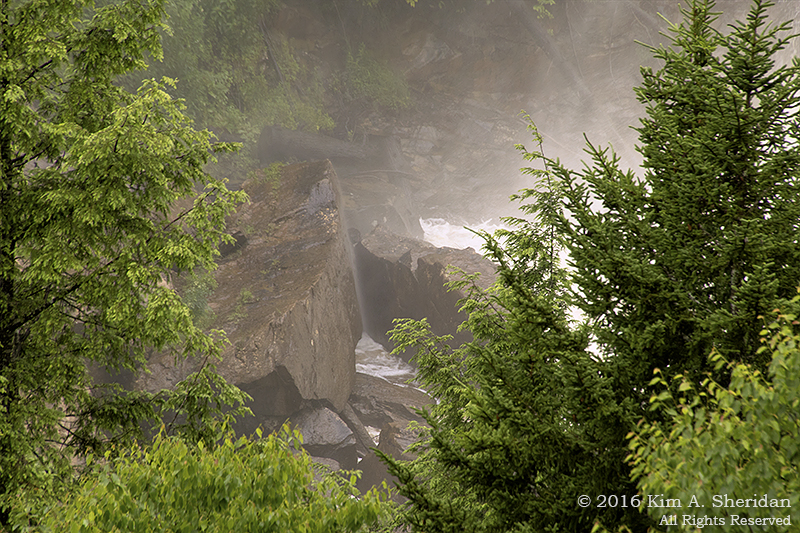
160705_WV Blackwater Falls_3114acsUpon hitting the bottom of the falls, water exploded back upwards to blanket the valley in mist. Everything nearby was soaked not from rain, but the river.

160705_WV Blackwater Falls_3186acsWe walked down the steps and the boardwalk, very carefully, to get up close to the falls.

160705_WV Blackwater Falls_3247acsRobb and Don, steeped in Nature’s Majesty. The roar of all that water made it impossible to hear anything quieter than a full-throated shout.

160705_WV Pendleton Point Panorama acsAt Pendleton Point, a panoramic view of Blackwater Canyon. The Blackwater River flows from left to right. In the center, Elakala Falls.

160705_WV Blackwater Pendleton Point_3017acsElakala Falls consists four separate waterfalls along Shays Run, until it finally spills into the Blackwater River.

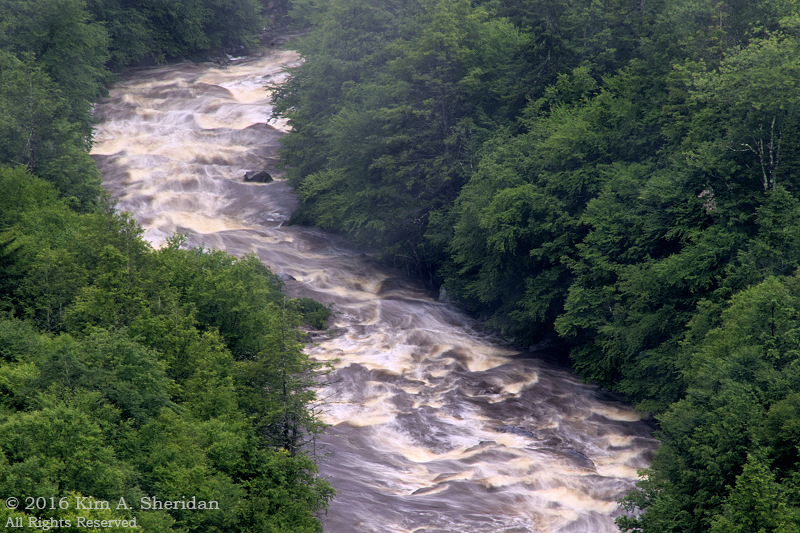
160705_WV Blackwater Pendleton Point_2968acsThe Blackwater River. Kayaking, anyone?

160705_WV Blackwater River_3132acsThe view from the bridge leading to the lodge. See that flat-topped rock on the right? On a previous visit to Blackwater Falls, Don was particularly impressed with that rock. Ah, fond memories!

160705_WV Blackwater Falls_3102acsBack at the falls, this time from the far side of the canyon.

From there, I made a short, shaky video of Blackwater Falls. (Click the link to see the video. That’s Robb’s voice in the background.) This was taken a lot further away from the falls than my previous video, which makes the roar of the falls all the more impressive.

All that power, all that force, in a material that feels so silken, so insubstantial. It slices through stone like a scythe – yet rests lightly in dewy drops on the gossamer petal of a flower.

Water. It’s amazing!

160704_WV Blackwater Lindy Point_2877acs

Almost Heaven: Seneca Rocks

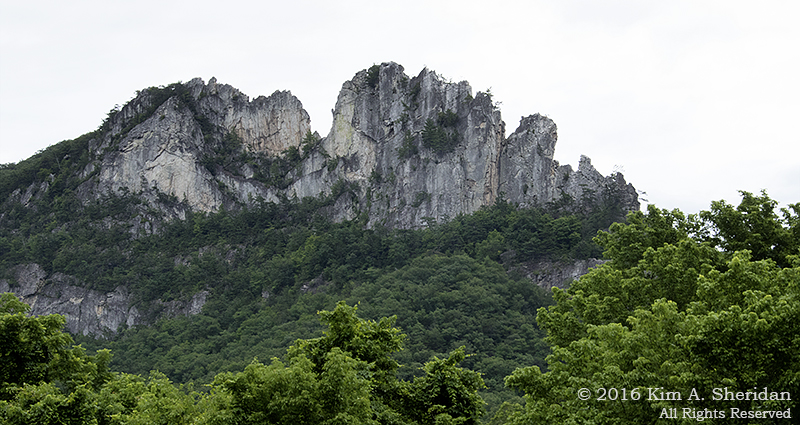
160703_WV Seneca Rocks_2442acsIt was an up and down kind of day. Our first full day in West Virginia’s Potomac Highlands began at a high rocky cliff and finished deep underground in a cavern.

Our first destination? Seneca Rocks, in the Spruce Knob – Seneca Rocks National Recreation Area in Monongahela National Forest. Our goal? To scale the craggy cliffs known as Seneca Rocks.

OK, maybe not. The cliff faces are a popular draw for experienced rock climbers with the technical skill and gear to handle one of the 375 different climbing routes. We were here to ooh and ah over the cliffs from below, and walk the trail to an observation platform just short of the North Peak.

160703_WV Seneca Rocks_2447acsDon posing in front of Seneca Rocks. Do you think he realizes Robb isn’t pointing the camera at him?

A Geological Diversion: The rocks at Blackwater Falls and many other places in the Potomac Highlands are sandstone, of the Tuscarora Formation. But Seneca Rocks are Tuscarora quartzite. Why?

     The sandstones of the area began forming over 500 million years ago. As mountains to the east were slowly eroded away, sand, silt and pebbles washed westward into a shallow sea that covered West Virginia at the time. The sediment settled and compacted into sandstone.

     About 275 million years ago, the collision of the continental plates forced the continental crust upward to form the Appalachian Mountains, and sandstone formations like Blackwater Falls were created. In some places, however, extreme pressure and heat caused the sandstone to change into quartzite, a metamorphic rock that is highly resistant to the weathering. Over time, softer stone eroded away to expose the “fin” or razorback ridge of Seneca Rocks.

160703_WV Seneca Rocks_2483acsIn the valley we stopped to admire the Sites Homestead, before crossing Seneca Creek.

160703_WV Seneca Rocks_2472acsWe also crossed the Potomac River. The North Fork of the South Branch of the Potomac River, to be exact.

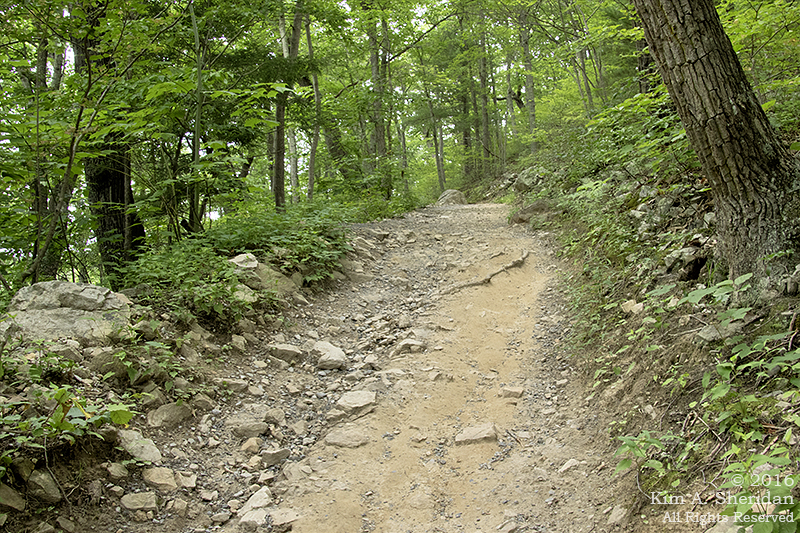
The trail gains 1000′ elevation in 1.5 miles through a series of steps and switchbacks. That’s pretty stiff. By my calculations, over a 12% grade. What fun!
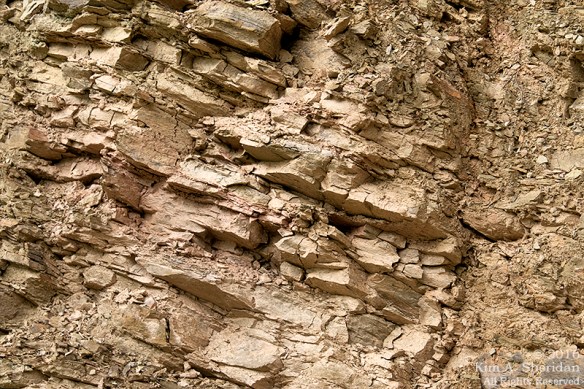
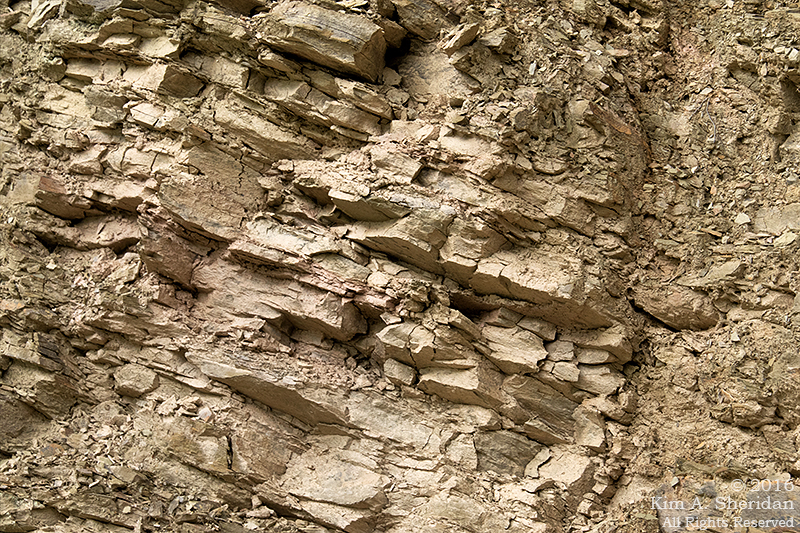
160703_WV Seneca Rocks_2542acsAlong the way up we passed a wall of sandstone. No, this photo isn’t crooked. Millions of years of geological uplift have left these layers tilted just so.

160703_WV Seneca Rocks_2559acsOne of many switchbacks. This photo isn’t crooked either, the trees grow that way. Trees like striped maple, birch, beech and oak, and some pines near the summit. I tried to get the entire switchback in the photo, but couldn’t without falling off the mountain.

We heard birds, but didn’t see much wildlife. Perhaps because there were a lot of folks out for a relaxing Sunday stroll. Most of them made it to the top, despite some questionable wardrobe choices. A lot of dogs took the trek, too. Near the start we encountered one little fellow with very short legs that already seemed to be struggling. Darned if he didn’t make it all the way up and back!

160703_WV Seneca Rocks_2576acsMushroom. No, the photo isn’t crooked! Plants and rocks alike grow at odd angles on steep mountainsides. Lots of lichens and mosses covered the rocks, and there were ferns everywhere. Wood ferns, sensitive ferns, and – look, Don! Christmas ferns!
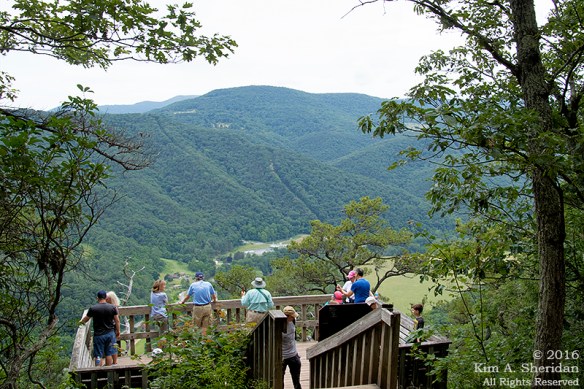
160703_WV Seneca Rocks_2601acsAt last! The overlook. I was somehow expecting a close-up view of Seneca Rocks. Instead, the observation platform, perched on the cliff side just below the North Peak, offers a fine view of the valley below and the mountains beyond. Don, front and center.
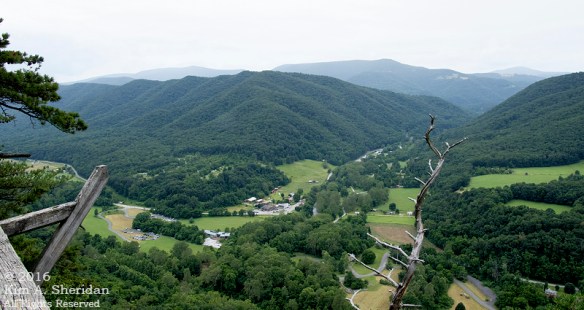
160703_WV Seneca Rocks_2609acsWhile I rest and enjoy a little snack, why don’t you join Don and take in the view.

Wait a minute, where’s Robb?

160703_WV Seneca Rocks_2730acsHe’s climbed up the rocky trail toward the top of Seneca Rocks, right past the huge STOP! sign warning of death and disaster to all who go past it – which everyone is ignoring. This is the North Peak, accessible without climbing equipment. Just because you can, doesn’t mean you should.
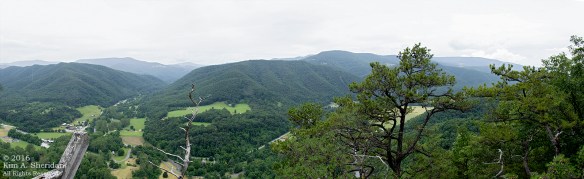
Seneca Rocks_Panorama1acsI want to go to the top, too! But just when I’m rejuvenated, Robb reappears, so we both head out onto the platform to enjoy the wonderful panorama. The pines on the right are Pinus pungens or Table Mountain pine, native to the Appalachian Mountains.

And what’s this? July Fourth weekend, at the top of a mountain; oh, it must be rain. Lovely.

With that, we took our last look over the valley and headed downhill. Fortunately, we were spared a repeat of last year’s Stony Man deluge; the rain this day was light and intermittent. The descent was much easier than the climb, and faster, too. Leaving us with plenty of energy to explore the rocky banks of the Potomac River.

The North Fork of the South Branch of the Potomac River.

160703_WV Seneca Rocks_2651acsA little way upstream, Seneca Creek flows into the river. Don and Robb decided to continue up the creek bed to the bridge, where I would meet them after retracing my steps along the trail.

Except when I got there, they were nowhere to be found, on the bridge or on the creek. I walked back to the Discovery Center in search of both the guys and a signal for my cell phone, and soon ran into Robb. Who claimed that they were RIGHT THERE on the creek bed, had SEEN me on the bridge, and SHOUTED at me repeatedly to no avail.

But I know I didn’t see them down on the creek. Couldn’t have been that I was looking the wrong way, could it? Nope, not me!
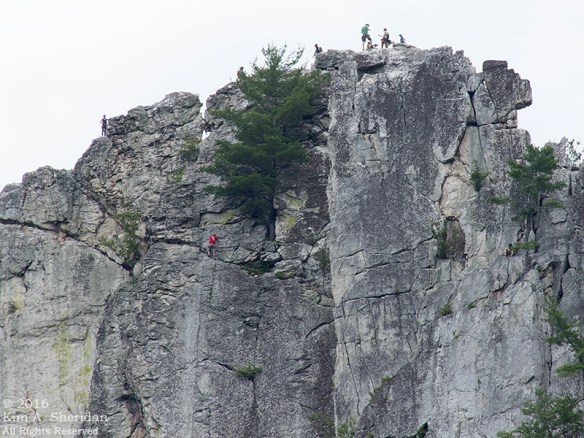
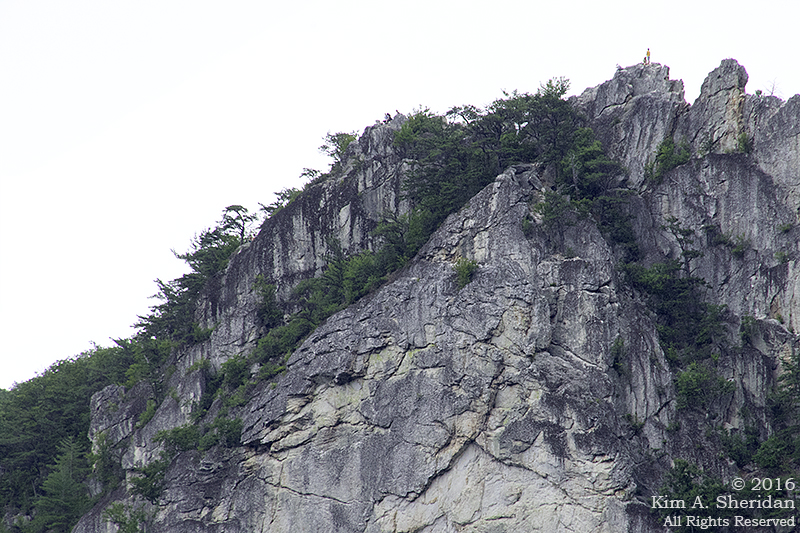
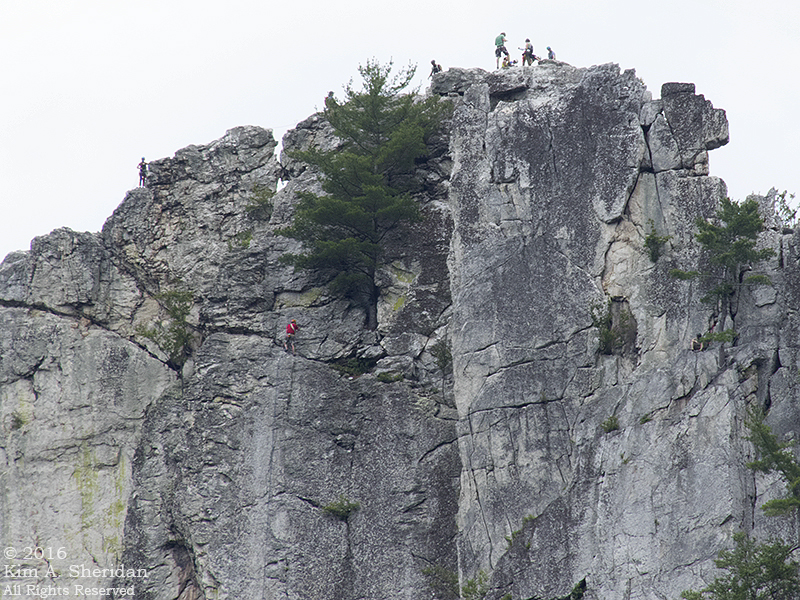
160703_WV Seneca Rocks_2703This is the South Peak of Seneca Rocks. Here we find the serious rock climbers doing the serious work of playing on cliff faces. How many climbers do you see? Seven (or more) on the top. Two on the face. Don’t see the second one? He’s at the right edge of the photo, resting in the shade of a tree. Maybe enjoying a good book.

Our plan had been to push on south to Spruce Knob, at 4,863 feet the highest point in West Virginia. When we passed the turnoff for Seneca Caverns, and the sign promised a restaurant, our hunger got the better of us and we changed plans. Happens all the time; besides, it was raining.
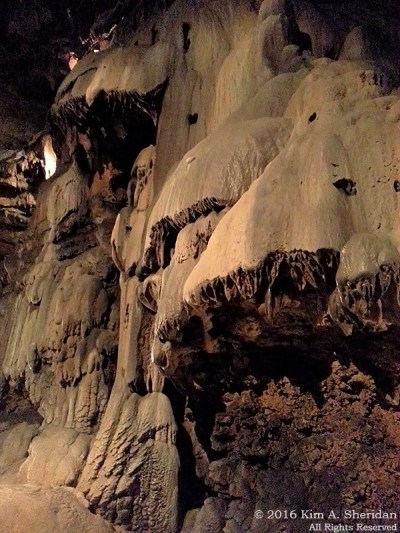
160703_WV Seneca Cavern_151809acsWe enjoyed the 45-minute tour through the cavern. It was considerably larger than either of the two Pennsylvania caverns we have been to.

Some of the rooms seemed to soar upward forever.

Then we came to some low, narrow passages that required yoga to weave through.

We never had to wear hard hats in a cavern before, but we were soon grateful for them. The trip leader’s talk was frequently punctuated by a plastic BONK! as one or another of the visitors hit their head on the low ceilings.

We finally emerged from the depths, to more rain and an hour’s drive to our snug cabin in Blackwater Falls.

160703_WV Seneca Rocks_2712acsTo plan for the morrow, and reflect on the highs and lows of a grand day in West Virginia.
Almost Heaven: Falling for West Virginia

160703_WV Seneca Cavern_154328acs

Country roads

Take me home…

Country roads feel like home, for that is where the journeys take place.

Journeys down sandy byways, through pines and marsh grass, to tea-colored rivers and salty bay beaches. Journeys down arrow-straight red dirt tracks, past wooden barns and fertile fields, to high dunes along crystalline lakes. Journeys down twisty two-lane roads, around hilly curves, to cliffs, meadows and waterfalls.

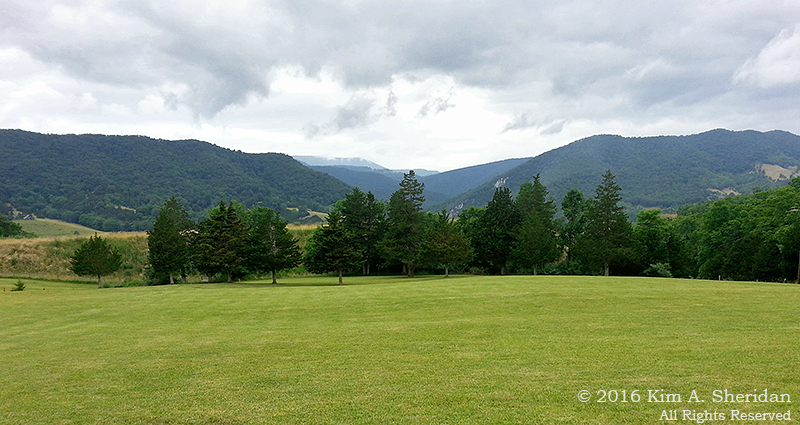
This Independence Day, those country roads took us home to the Appalachian Mountains. Home to a luxurious (and affordable!) cabin in Blackwater Falls State Park in West Virginia. By day, Robb, Don and I explored the Potomac Highlands region, a land of steeply folded mountain ridges, deep gorges and broad valleys.

160702_WV Blackwater State Park_151107CellacsAfter checking into our cushy cabin, acquiring some vittles, and enjoying a yummy buffet at Blackwater Falls Lodge, we took our first look at Blackwater Canyon, 500 feet below. From on high, the Blackwater River is a pale ribbon woven through an undulating blanket of green.

Up close, the forest resolves to trees of Eastern hemlock and red spruce, American beech and striped maple. Bracken ferns carpet the forest floor, alongside dense thickets of rhododendrons.

160704_WV Blackwater Falls_2822acs

Conservation Piece: We saw lush stands of Eastern Hemlock all over the higher elevations of the Potomac Highlands, which top out over 4,000’. It’s hard to imagine the mountains without this beautiful tree. Yet the hemlocks are besieged by an invader from Asia, the hemlock woolly adelgid (ah-DEL-jid.) These sap-sucking insects appear as small white clumps on the twigs and needles and pose a serious threat to Eastern hemlocks throughout the Appalachians.

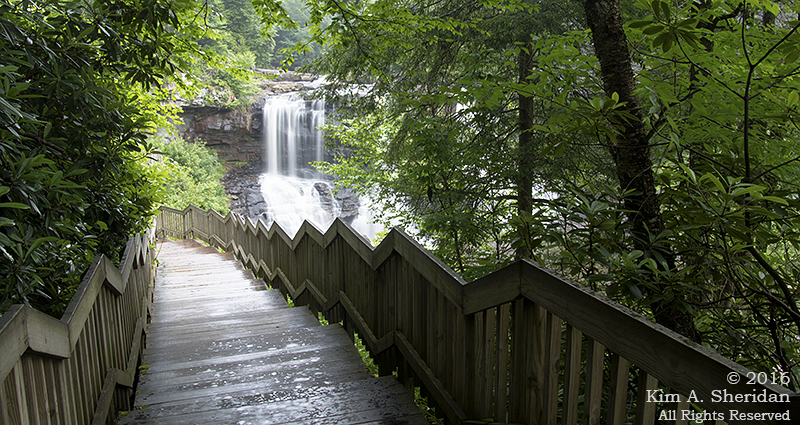
Not one day in the park could pass without a visit to Blackwater Falls. The trail is a wooden walkway interspersed with strategically placed landings amid more than 200 steps. At the bottom is a long boardwalk with an overlook near the base of the falls.

160704_WV Blackwater Falls_2778acsWe could see glimpses of the falls through the trees as we descended. We could hear the falls even before we got to the trail.

160704_WV Blackwater Falls_2751acsThe classic tableau of Blackwater Falls.

160704_WV Blackwater Falls_2768acsLooking at the Falls in this orientation begins to give an idea of their size. The main drop is 57 feet.

What isn’t conveyed is a feel for the depth of the gorge through which the Blackwater River runs.

Or the force of the water. I asked Don, who’s been to Blackwater Falls a few times, how this stacked up in terms of relative water flow.

He said that this was one of the highest flows he’s witnessed at the falls, though he’d seen it higher.

A photograph can’t convey the other sensory delights of Blackwater Falls: the scent of hemlock, spruce and rich wet earth; the feel of mist blowing back from the falls; the roar of water plunging over the ledges.

Except…my camera takes videos. I rarely remember this feature, but I did this time. Click here for a 20-second video of Blackwater Falls and be sure the audio is turned up!

By the way, all of these photos were taken, not on our first night in the park, but the morning of July Fourth, two days later, while my traveling companions were still in dreamland. Tee-hee – I had the falls to myself. Heaven!

160704_WV Blackwater Falls_2809acsAbove the Falls is a 40-foot cliff of sandstone, a sedimentary rock composed of quartz and sand. We saw a lot of sandstone in the gorge and throughout the Highlands.

160704_WV Blackwater Falls_2756acsThe most prominent ledge of the Falls. A lofty pulpit draped with satin vestments and backed by a rhododendron choir. Say “Hallelujah!” and pay attention to the preacher – there will be a quiz later.

160704_WV Blackwater Falls_2783acs

The baptismal font runneth over.

The Blackwater River gets its dark tea-color – and its name –  from tannins in the soil of the hemlock and spruce woods and marshes through which it passes. Much like the rivers of the Pine Barrens are tea-colored from pine tannins. The similarities between the Pinelands and upper elevation habitats in Appalachia never ceases to amaze me.

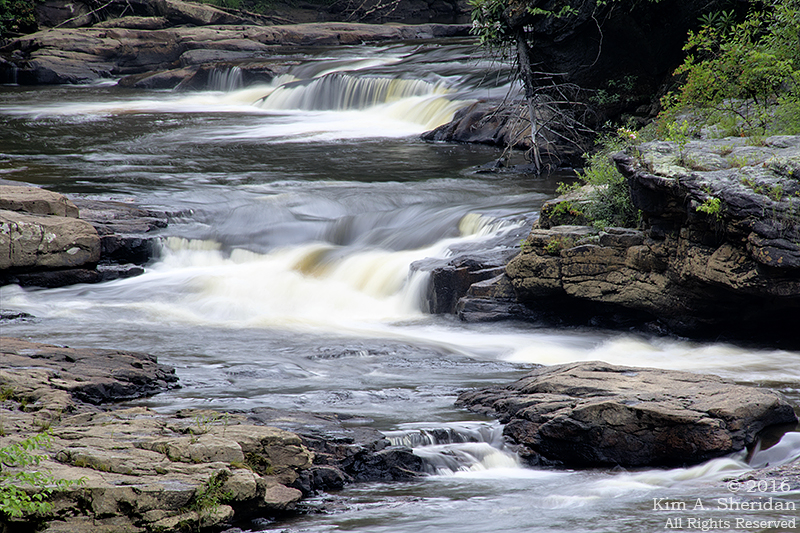
160704_WV Blackwater Falls_2765acsAbove the falls, water cascades down a cockeyed staircase.

160704_WV Blackwater Falls_2811acsThe river below the Falls threads through a jumble of sharp sandstone boulders under verdant tree boughs.

160704_WV Blackwater Falls_2773acsLong after the trees are gone…

and the rocks tumbled to sand…

the mountains will endure…

yielding but ever so slowly to dark water’s caress beneath the bridges of time.

160704_WV Blackwater Falls_2789acs

Life is old there, older than the trees

Younger than the mountains, growin’ like a breeze

Country Roads…

Where will you take us next?

Lyrics to “Country Roads” by John Denver, et al.


The Turtle 200

Critter Radio Logo v3Welcome back, race fans, to the annual Turtle 200! It’s been a year since the armored beasts took to the track. We have a good lineup of reptilian racers for you today, all tuned up and ready to roar down the track at a breakneck quarter-mile an hour. You can hear all the action right here on KRTR 99.9 FM, Critter Radio. Tension is mounting!

160526_PA HNWR Morning Turtles_8388acaThere’s quite a crowd watching the action from the turtle bleachers. They crane their necks for a better view as the competitors plod past.

160526_PA HNWR Morning Turtles_8379Every stadium has that one guy, right? Big, pushy, late to the party, he has to climb over everybody to get to his seat. Today it’s a Red-bellied Turtle throwing his weight around amongst the smaller patrons.

The Red-bellied Turtle, sometimes called a Red-bellied Cooter, likes deep water with a sandy or muddy bottom and lots of aquatic vegetation. They sometimes hang out in the sun with Painted Turtles and Red-eared Sliders, but they are much larger. They are distinguished by their reddish plastron, the lower shell. Red-bellied Turtles are listed as a threatened species in Pennsylvania. Loss of habitat is taking its toll, as is nest predation, road mortality when females come on land to lay eggs, and competition with the exotic Red-eared Slider.
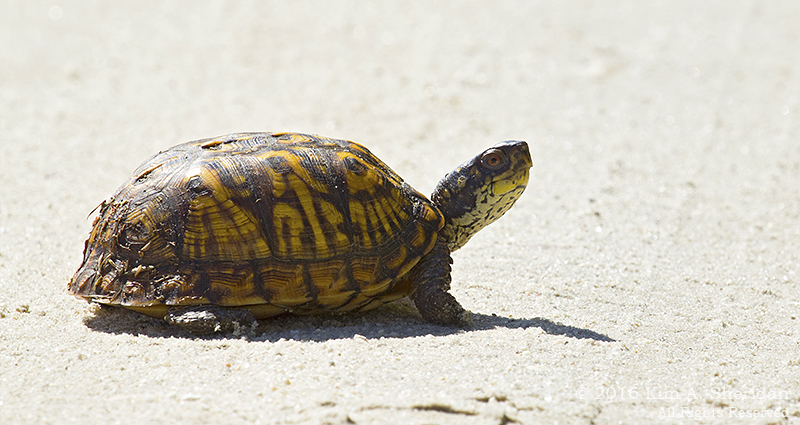
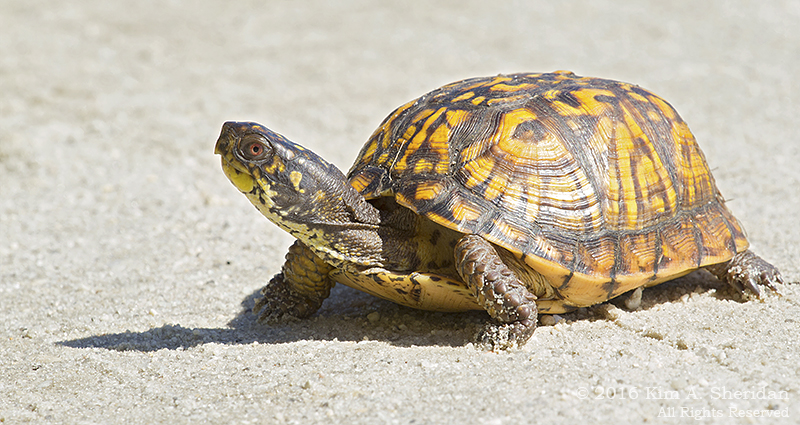
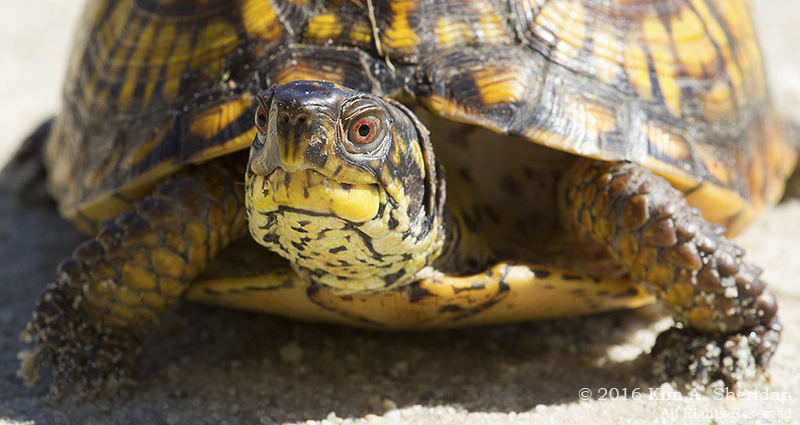
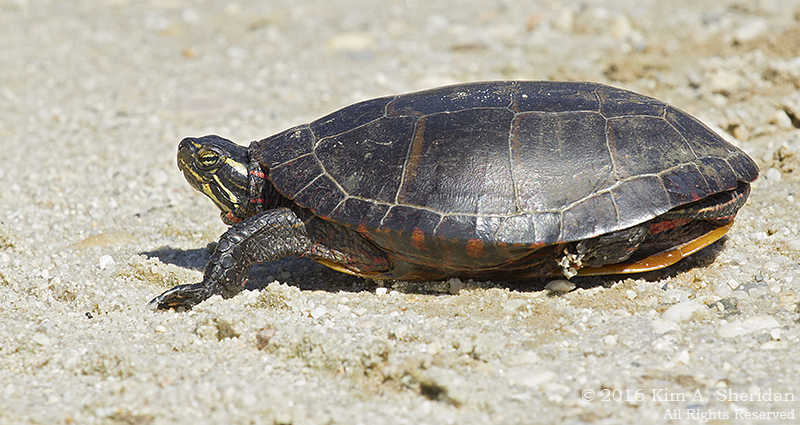
140926_Forsythe NWR_3589acsHere we go, fans! Coming into the first turn is an Eastern Box Turtle. Surprising to see him in the lead. Box Turtles are known to be particularly slow, which is saying something when you’re talking about turtles. Look at the domed carapace (upper shell) on this guy!

140926_Forsythe NWR_3606acsLooks like he’s made the turn safely. He was really pulling those Gs though!

140926_Forsythe NWR_3618acsThe look on his face says it all.

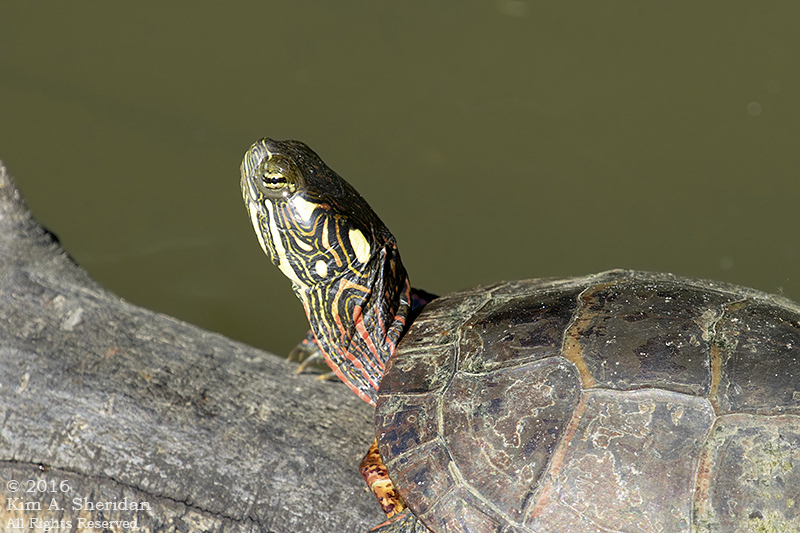
160531_PA HNWR Evening_9169acsThis Painted Turtle shows some uniquely beautiful markings as he strains his neck going around the curve.

FUN FACT: A few species of turtles have an eye stripe like this. A fellow photographer pointed out that, no matter what angle the head and neck are, that eye line is always parallel with the horizon.
Wait! The Caution flag is up!

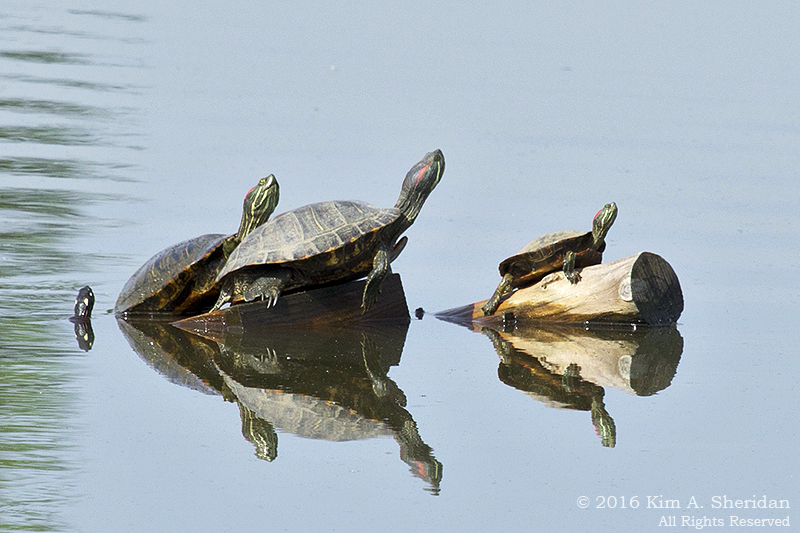
160526_PA HNWR Morning Turtles_8341acsSeems we’ve got a three turtle pileup of Red-eared Sliders on the track.
Red-eared Sliders look quite similar to Painted Turtles, and the two species frequently sun together. The red stripe on the side of the Slider’s head gives it away. They don’t belong here; they are native to the Mississippi River Basin. But they are popular pets, and frequently released into the wild, so that they have become established throughout the country. They often out-compete other turtles, the hallmark of an invasive species.

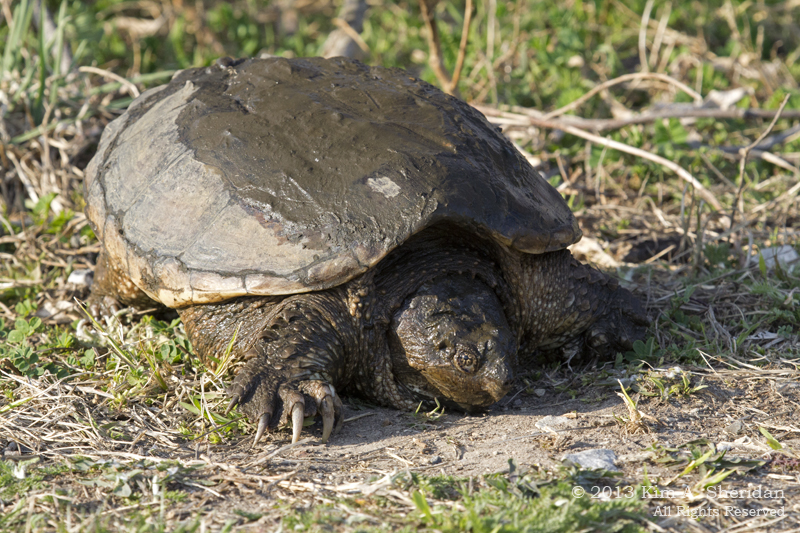
HNWR Snapper_6644 ASNow we’ve got a green flag, we’re back to racing. A snapping turtle has lumbered into the lead.

This is one BIG turtle! They can reach 60 pounds. Everything about them, from their heads to their claws, is huge. You don’t want to get near their powerful jaws.

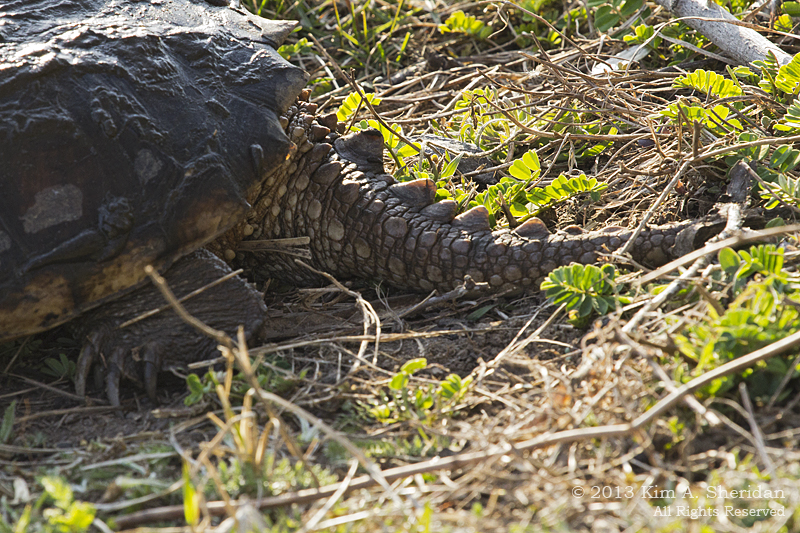
HNWR Snapper_6657 aThe Snapper meanders on down the track, dragging his very impressive tail behind him.

06222016_DE Bombay Hook Terrapin_2130acsThe White flag is up – it’s the final lap. A Diamondback Terrapin moseys toward the finish line.

She’s almost there…

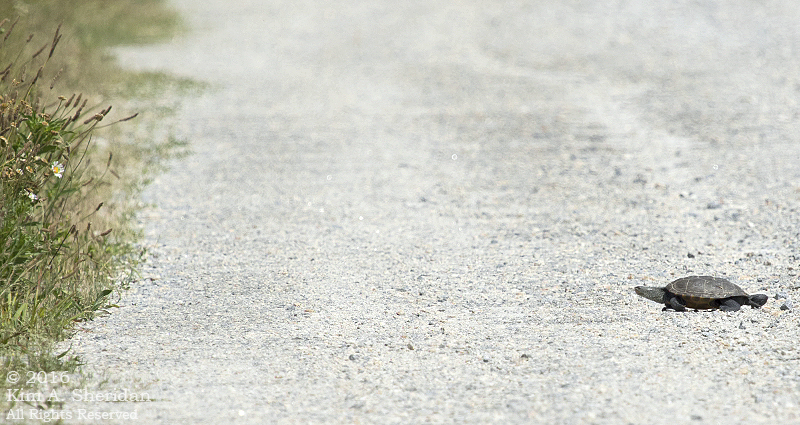
06222016_DE Bombay Hook Terrapin_1481acs…AND she’s pulling over for a pit stop. In an actual pit, which she’s digging herself to lay her eggs. Right in the road. Track managers frown on this type of behavior; it makes a mess for the grounds crew to clean up. In the meantime, this beautiful female has cost herself the trophy.

Diamondback Terrapins are turtles of brackish estuaries, tidal creeks and marshes. They are the only turtles in the country that live in water with a salt content between that of fresh and salty seawater. Population numbers are dropping due to habitat loss, and predation. Females crossing roads to lay eggs are killed by cars, they are collected illegally for the pet trade, and frequently drown in commercial crab traps. Numerous conservation programs are trying to help these beautiful turtles.

160526_PA HNWR Morning Turtles_8110acsNow another Snapper is gliding toward the finish line…

Oh, the drama! The Snapper had the finish line in his sights, only to be passed by a Painted Turtle in the last few yards as the checkered flag waves.

140926_Forsythe NWR_3555acsThere’s your winner, folks: the Painted Turtle has taken the coveted Turtle 200 Cup!

That’s another fine race in the history books. Don’t miss next year’s competition, brought to you by KRTR 99.9 FM, Critter Radio. It’s sure to be another nail-biter!

We leave you now, as always, with the words of the incomparable Ogden Nash:

The turtle lives ‘twixt plated decks

Which practically conceal its sex.

I think it clever of the turtle

In such a fix to be so fertile.

Stilted

160610_DE Bombay Hook Stilt_0946acsStilted [stil-tid]: Stiffly dignified or formal.

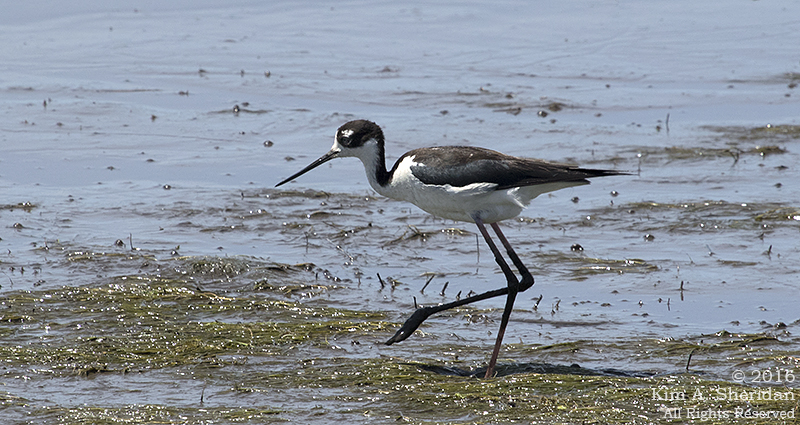
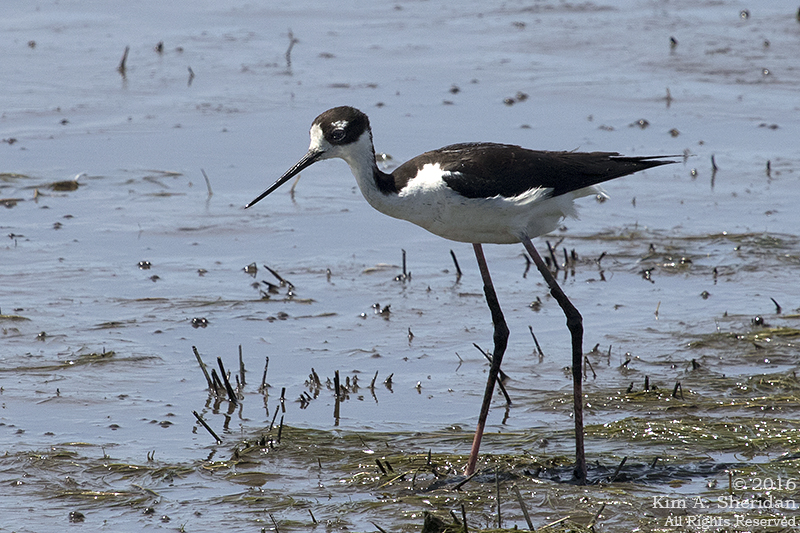
Hmmm. Ok, this bird could be described as “dignified or formal.” This is a Black-necked Stilt, a slender shorebird with long red legs. In his black and white attire, he seems ready for a formal affair.

I coaxed my friend Don into a trip to Bombay Hook National Wildlife Refuge along Delaware Bay in Delaware on my birthday a few weeks ago. I’m not sure what I was hoping to see. Ospreys, Harriers, Egrets.  American Avocets, if we were lucky. Foxes, maybe.

We weren’t expecting Black-necked Stilts. And we certainly weren’t expecting to see the behaviour we witnessed. I’ve only seen Black-necked Stilts at this Refuge, and only a couple of times.  Always it’s been one or two birds, far across the impoundments, difficult to see and impossible to photograph.

Yet, here they were, Stilts close enough to the Wildlife Drive to see and photograph. We were thrilled to watch these elegant and formal birds.

160610_DE Bombay Hook Stilt_1273acs“Stiff” is not a word that describes the Stilt, though. On land they tip forward on those long legs to forage for invertebrates and small fish, then agilely twist to groom themselves.

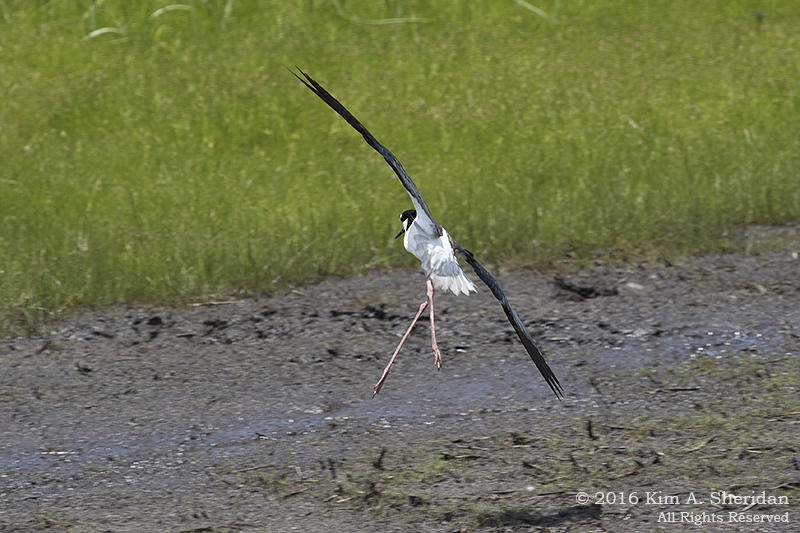
06222016_DE Bombay Hook Stilts_1951acsIn flight they are graceful and airy.

160610_DE Bombay Hook Stilt_1015acsA little further down the road, we found more Stilts, and things began to get interesting. Two pairs of birds were flying in a looping, elaborate aerial dance.

160610_DE Bombay Hook_0981acs2A dance it was indeed, as these couples were clearly engaging in a courtship display.

160610_DE Bombay Hook_1332acsTurning and wheeling with long legs dangling, they put in mind ballet dancers in tuxedos leaping across a stage.

160610_DE Bombay Hook_0819acsWe also witnessed another pair mating.

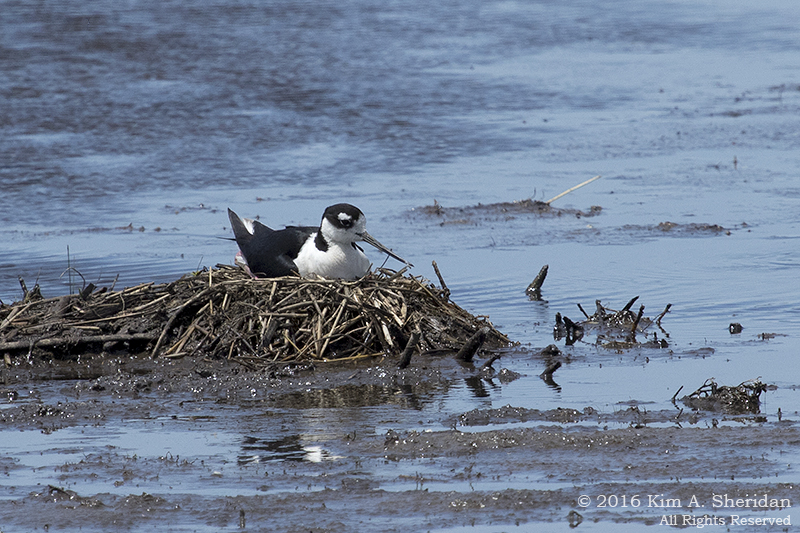
160610_DE Bombay Hook_1451acsYet another Stilt, sitting on a nest, incubating eggs. Stilt nests are scrapes in soft ground. Often they are on small islands surrounded by shallow water.

In the course of a few hours, we saw the entire range of breeding behavior, from courtship display to mating to nesting. We felt lucky to get this little glimpse into the lives of Black-necked Stilts.

But wait. If there’s a nest so easily viewed from the road, might there be babies to see in the future?

Two weeks later Don and I found ourselves back at Bombay Hook, hoping to see Black-necked Stilt chicks. We weren’t disappointed!

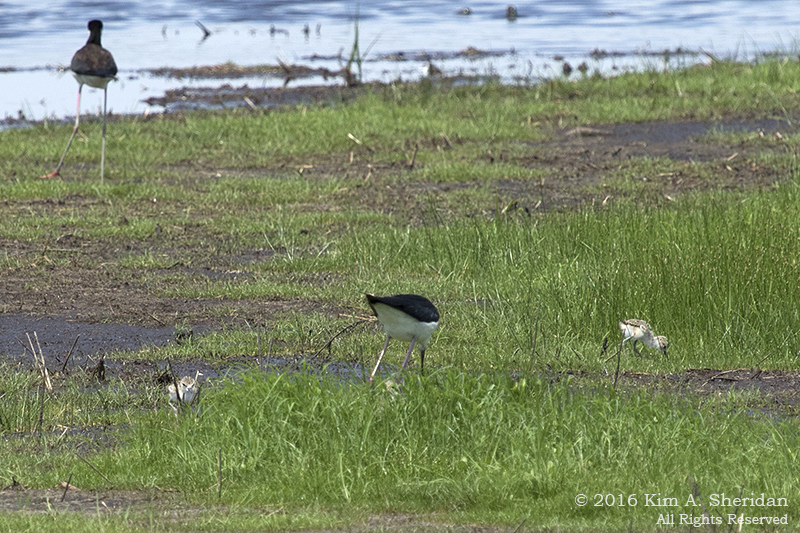
06222016_DE Bombay Hook Stilts_1911acsWe found the Stilt family on a low island of green grasses in one of the Refuge’s pools. Two adults, and three chicks. They are all visible in this photograph, although you have to look hard for the third chick. Its head is barely visible just in front of the right-hand adult’s feet, nearly lost in the green grass.

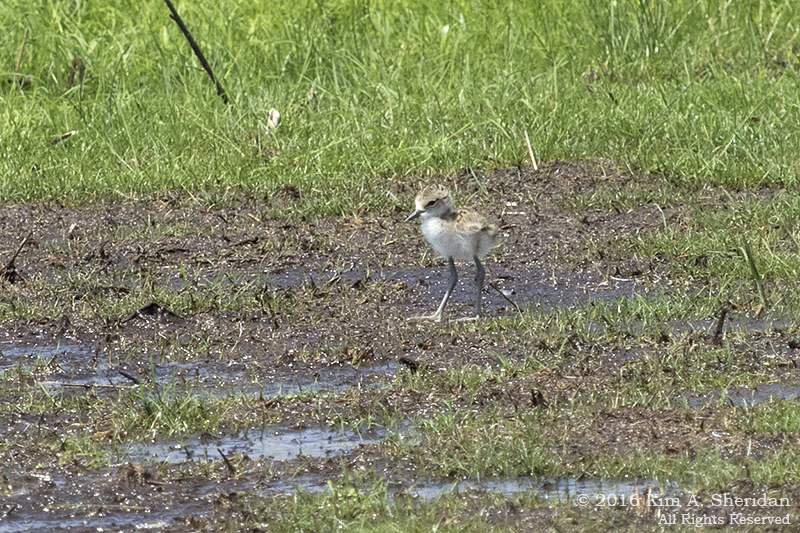
06222016_DE Bombay Hook Stilts_2221acsCuteness Alert! This little ball of fluff is irresistible. A pom-pom on two long slender sticks.

06222016_DE Bombay Hook Stilts_2239acsStepping out. Stilt chicks are able to walk and forage on their own with hours of hatching. It will be some time before they grow feathers and learn to fly, though. Until then, this tiny island is their entire world. Their parents are vigilant, constantly on guard for any possible threat.

06222016_DE Bombay Hook Stilts with Egret_2400acsLike a Great Egret that landed too close for the Stilts’ comfort. One parent took several passes at the Egret. When it moved even closer, the Stilt had seen enough, and aggressively chased the intruder away. Never underestimate the smaller bird if it has chicks to protect.

160610_DE Bombay Hook Stilt_0941acsDon and I had thought ourselves lucky to witness the breeding behavior of Black-necked Stilts. We felt positively privileged to spend time with the adorable fluffy offspring of these elegant and distinguished birds.

My Big Day

160531_PA HNWR Evening_9311acsA “Big Day” in bird-watching parlance is a day when a group of birders try to see as many different species of birds as they can. Recently, I had a different kind of Big Day.

My life list on May 13 consisted of 211 different bird species. On May 14, it was up to 217. That’s a big jump. How?

I saw six new birds in ONE day, that’s how. My BIG DAY.

But do I have photographic evidence? No!

Murphy’s Law of Bird Photography: Go out, camera in hand, in search of stunning photographs of the brightly colored migratory warblers that appear like magic every May, and either:

a) there are no birds, or

b) there are plenty of birds, but they are moving so rapidly deep in the dark treetops that all of your images are rubbish.

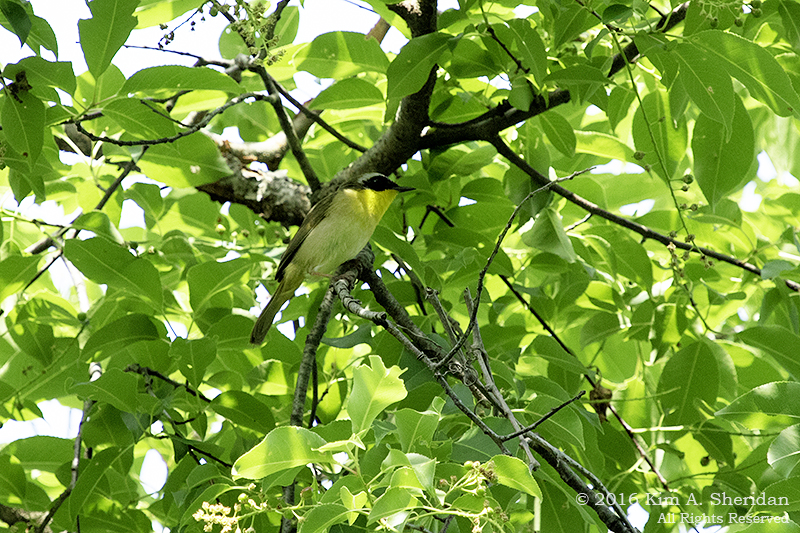
160526_PA HNWR Morning Birds_8263acsLike this Common Yellowthroat, so buried in the foliage that its light underparts look green from the reflection of the leaves.

Common Yellowthroats, as their name implies, are pretty common. One hopped across my porch while I was reading one evening. I enjoy seeing them each year, but this was not a new species, a “life bird”, for me.

160428_PA HNWR Warblers_6824acsHere’s a bird in the open, an American Redstart. Great bird, horribly distracting background, too bright. Another common warbler I’ve seen before this year.

John Heinz National Wildlife Refuge is a hotspot for migrating warblers, flycatchers, vireos and other birds in the spring. Many of the local birders said this was the best spring migration we’d had in some years.

Murphy’s Law of Bird Photography, Corollary #1: Go birding WITHOUT the camera, and the birds will sit in the open in beautiful light, singing their hearts out.

See the above incident on the porch. Great bird, really close, no camera.

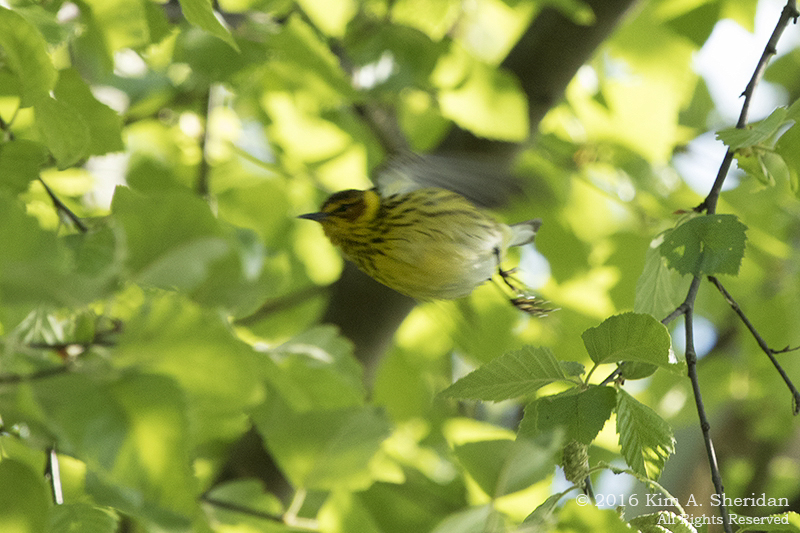
160515_PA HNWR Warblers_7779acsHere’s the one life bird I saw this spring I managed to capture, a Cape May Warbler. I first saw it the day before at eye level, in the sun, singing away. But, alas, no camera. I found it again the next day with camera in hand; this time it was hidden in the trees. I finally caught it in a blur of motion. This nicely illustrates one of the habits that make warblers so difficult to photograph: they never stay still!

Murphy’s Law of Bird Photography, Corollary #2: Have a Big Day, in which you see SIX new species of warblers, and your only passable images will be of the ubiquitous Yellow Warblers. All thanks to Murphy’s Law of Bird Photography or Corollary #1.

160428_PA HNWR Warblers_6688acsHere’s that ubiquitous Yellow Warbler. Notice how all of my images are of the birds’ tummies? Another warbler habit: Most species like to hang out high in the trees. To see many of them you need to tilt your head way, way back. There’s a reason warbler fans complain of “Warbler Neck.” Most of my images are of birds that hang out a little lower in the canopy.

For those curious to know, my new birds this May were the Blue-winged, Cape May, Wilson’s, Blackpoll, Chestnut-sided and Canada Warblers and the Northern Parula. All but the Blue-winged seen in one day.

Murphy’s Law of Bird Photography, Corollary #3: Have a bird pose in the open for you to photograph, and that’s the bird that might have been a lifer, but you’ll never know for sure what it was.

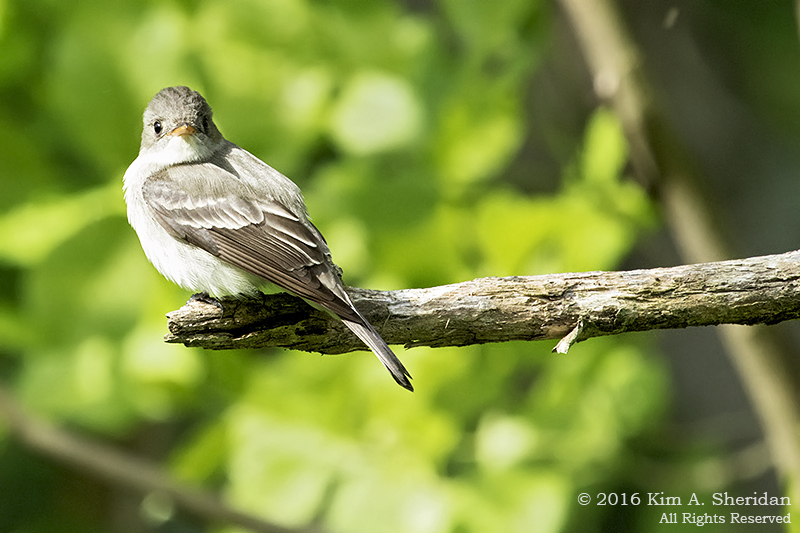
160515_PA HNWR Warblers_7861acsI was with one of the Refuge’s finest birders, and she wasn’t willing to say definitively which flycatcher this was without hearing it sing. Despite posing for a long time in the open, it never opened its mouth.

It was a real treat to bird with Edie, though. Birding with friends was the only reason I was able to add so many new life birds to my list. I wouldn’t have found some of them if other pairs of eyes hadn’t been searching too. I wouldn’t have been able to identify some of them if others hadn’t helped me out.

There are other birds at the Refuge that are easier to see and photograph.

160516_PA HNWR Oriole_7952acsBaltimore Orioles are stunning at this time of year.

160428_PA HNWR Swallow_6499acsBarn Swallows are everywhere. Trying to capture them in flight is nearly impossible. But they’re not shy when they’re sitting on the boardwalk railing.

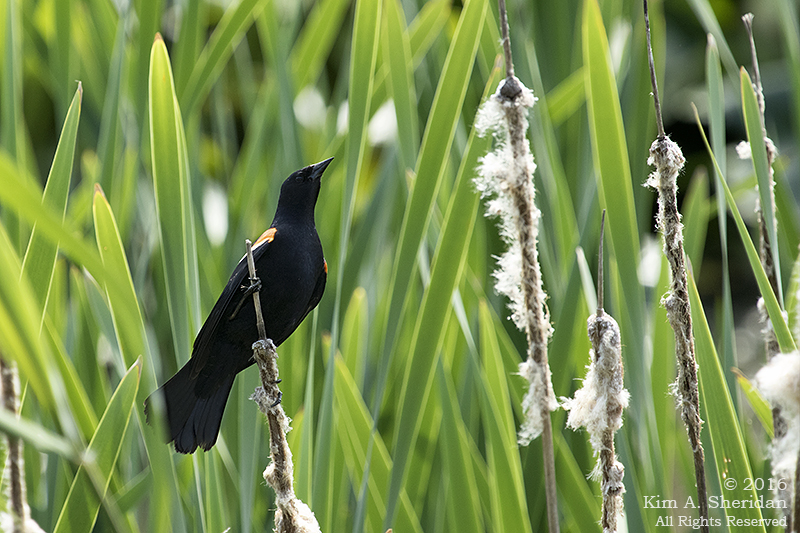
160526_PA HNWR Morning Birds_8554acsRed-winged Blackbirds are another common bird that I keep hoping to capture in flight. Sitting among the cattails will have to do.

Speaking of common birds in flight at the Refuge, that’s a Great Blue Heron at the top of this post.

160531_PA HNWR Evening_9265acsI’ve been trying to photograph male Wood Ducks in their elaborate breeding plumage for a long time, not particularly successfully. I’ll take the ducklings any day of the week, though. They’re hot on Mama’s tail as she paddles for the safety of the spatterdock.

Every day’s a Big Day for Mama Wood Duck.

Every day that I am outside observing and enjoying Nature is a Big Day for me.

The Return of the Flickers

They’re back!

160608_PA Home Flickers Return_0043acsA month ago, a Northern Flicker pair had spent days preparing a nest hole in my gray birch tree, only to be evicted by a squirrel.

Then House Sparrows moved in, to be booted out by squirrel in turn.

Now there’s a male flicker in the cavity.

Will he and his mate successfully raise a brood of little flickers?

Or will the squirrels chase them away again?

Stay tuned…

Missed the beginning of the tale? Here it is:

Excavation

Eviction Notice

The Hunt for Doan’s Cave

160509_PA Doans Cave_7226acsBUCKS COUNTY, 1781… A band of ruthless outlaws known as the Doan Gang rob the Bucks County Treasury in Newtown of 1,300 pounds sterling. It was one of many crimes committed by five Quaker brothers and their cousin. Loyal to the British crown, the Doans made a career out of robbing Colonial tax collectors, stealing horses to sell to the British and even spying for the Redcoats. According to numerous legends, the gang amassed a small fortune, and stashed the loot in one or more caves in the hills of Bucks County.

BUCKS COUNTY, 2016… A band of intrepid explorers go in search of the Doan Gang spoils. The most well-known of the caves is rumored to be along the banks of Tohickon creek. The only clue to its whereabouts is a small dot on a Bucks County map labeled “Doan’s Cave.”

Well, that and a few Internet photos and postings that serve as a signpost to the impossible-to-miss cave.

Conveniently, there’s a State Park, and a trail.

160509_PA Doans Cave_7170acsThe latter was a scenic walk along the creek, with a couple of tricky crossings over steep banked runs that fazed our daring adventurers not one whit. Soon enough, rock outcroppings began to appear on the hillside above them. Just the place for a cave.

160509_PA Doans Cave_7210acsThe first such outcropping held no cave, but sported an impressive covering of lichens and moss. It was also an irresistible place for some camera-mugging by the irrepressible Major Robb, not seen here.

160509_PA Doans Cave_7218acsThe next rocky formation had been cleft nearly in two on one end. Two trails split around it. Which to follow?

Left, and down, to the base of the rocks.

160509_PA Doans Cave_7272acsBehold! Doan’s Cave!

160509_PA Doans Cave_7253acs copyObviously our heroes were far from the first to seek their fortune here. Someone had even been kind enough to put down cushy floor boards for their fellow treasure hunters.

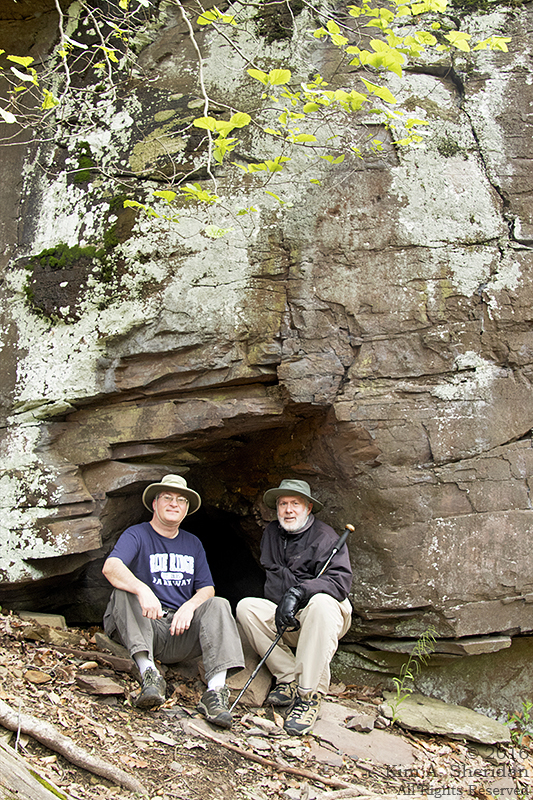
160509_PA Doans Cave_7249acsMajor Robb and Major Don at the mouth of Doan’s Cave…

160509_PA Doans Cave_7188acs… And standing stalwart and resolute amongst the boulders. Why does Major Don look so sad?  Clearly the disappointment of finding no Doan Treasure in Doan’s Cave weighs heavily upon his mind.

160509_PA Doans Cave_7332acsBeing lighter of heart, the other members of the expedition make a foray to the shores of Tohickon Creek.

160509_PA Doans Cave_7158acsOur fearless fortune-hunters, finding no gold or silver, went off in search of other types of treasure. This they found in spades on the far side of the creek. The footpath led over a covered bridge, which was in fact not covered at all. A faux bridge.

The creek-side path yielded a bumper crop of wildflowers. This was a source of boundless amusement for Major Robb, who busied himself attempting to identify each one. Conveniently for the rest of the expeditionary party, it got him out of their hair.

160509_PA Doans Cave_7176acsSpring beauty.

160509_PA Doans Cave_7349acsPhloxWild Blue Phlox.

160509_PA Doans Cave_7358acsDamesVioletDame’s Violet.

160509_PA Doans Cave_7345acsVioletA violet, unnamed, but no less admired.

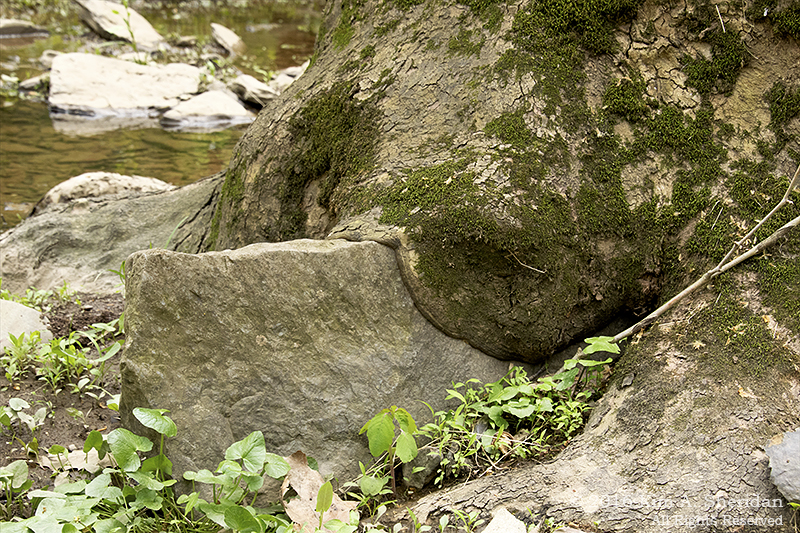
160509_PA Doans Cave_7415acsWhilst Major Robb was so occupied, the others found their way across a dry gully onto an island of cobble and pebbles. Here a tree was actively swallowing a large rock. In another hundred years, it might well succeed in digesting this stony meal.

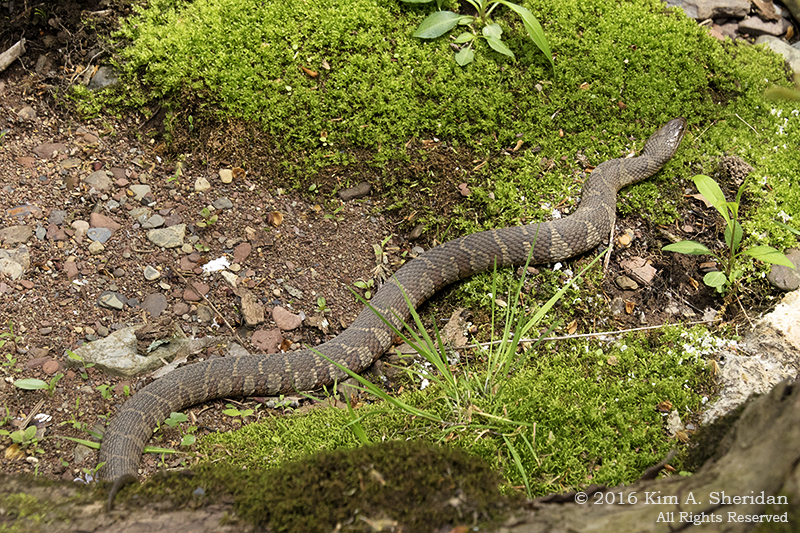
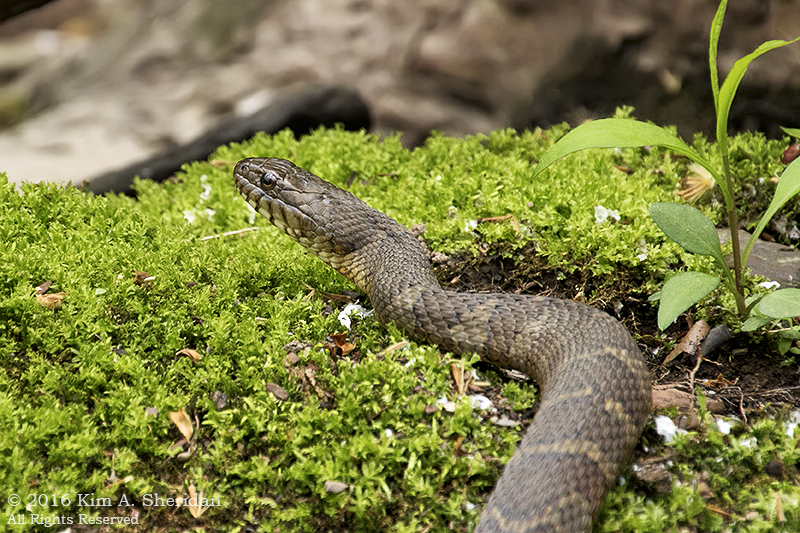
160509_PA Doans Cave_7373acsCorporal Kim was suddenly startled by the sight of a large snake at her feet, slithering away from her with all due haste. Seems the plucky lass had unwittingly trod upon its tail. Upon reaching the water’s edge, it forgot its annoyance and fear, and posed quietly for a series of photographs.

160509_PA Doans Cave_7385acsNorthern Water Snake.

160509_PA Doans Cave_7325acsTired, hungry, and quite bereft of treasure of any monetary value, our bold band of explorers bid farewell to Tohickon Creek. Quite content were they with the joys of a day well-spent amidst the natural splendors of Bucks County. Whatever secrets Tohickon Creek yet harbors, she guards them well.

In The Neighborhood

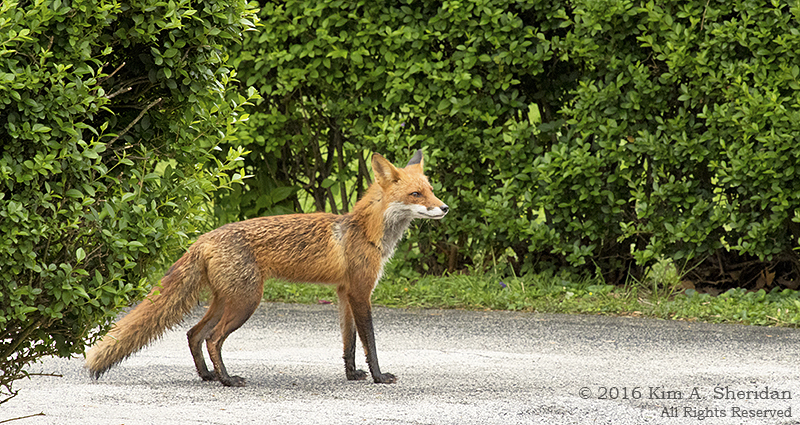
160505_PA Home Fox_6938acsLook who dropped in for a visit!

I live in a suburban development built in 1950. Rows of three-bedroom houses flank sidewalk-lined streets. Lots one-tenth of an acre in size are carpeted in grass, lined with ornamental trees and shrubs and gardens full of non-native flowers. The nearby school draws many children, and car traffic is heavy during the busy times of the day.

In other words, there’s not much habitat here for wildlife.

Yet wild critters exist here, and even thrive. Many of the “backyard” bird species are here. Northern Flickers and House Wrens have nested or tried to nest in my birch tree, there’s another nest with babies in my American holly, and last week while I was reading a Common Yellowthroat warbler walked across my porch as bold as you please.

I’ve seen garter snakes in my rock pile, and twice painted turtles took a slow amble through my garden, headed to I don’t know where.

Squirrels and rabbits abound. Raccoons, opossums and small mammals like field mice are around. We don’t often see them, but might see evidence of their passing. To my disappointment, my neighborhood lacks chipmunks.

It doesn’t lack red foxes, however. One of these beautiful animals paid a visit early one morning. There is a park a few blocks away. Though it is mostly open grass and playground equipment, it seems to be adequate habitat for the fox family that lives there.

I suspect more than a few of the neighbors are not happy with the presence of the foxes. They worry that the foxes might carry disease or eat their pets. They might like to see them removed; after all, this is a humans’ world, and wildlife has no place in it.

Yet many also complain about rabbits raiding their vegetable gardens, and shriek at the sight of a mouse. Those small mammals make up a good portion of the diet of a red fox. Remove the predators, and there will be more rabbits to eat your vegetables and mice to get into your house.

Life is a complex web of interrelationships amongst the animals and plants. All are dependent for survival on each other. Through technology and industry, humans have largely removed ourselves from that web. But we still share our space with creatures large and small, and should respect their right to life on their own terms.

Foxes in the neighborhood remind us that even here we live on the Wild Edge.

Birthday Flowers

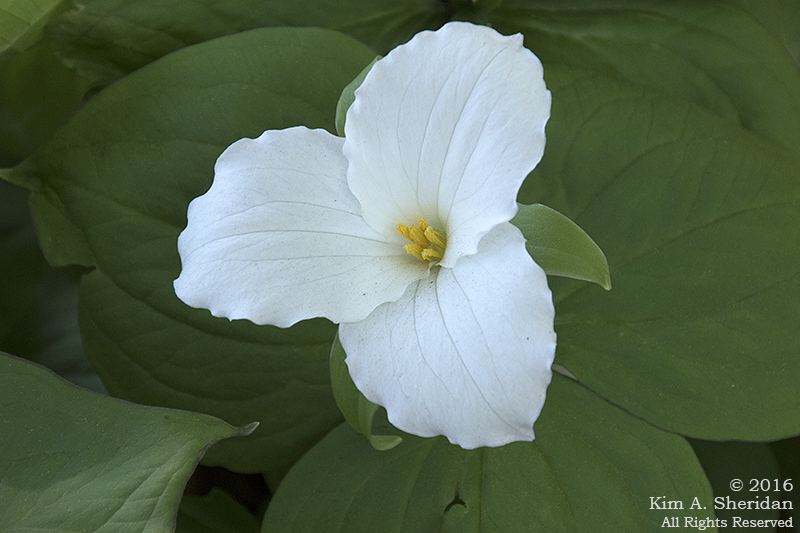
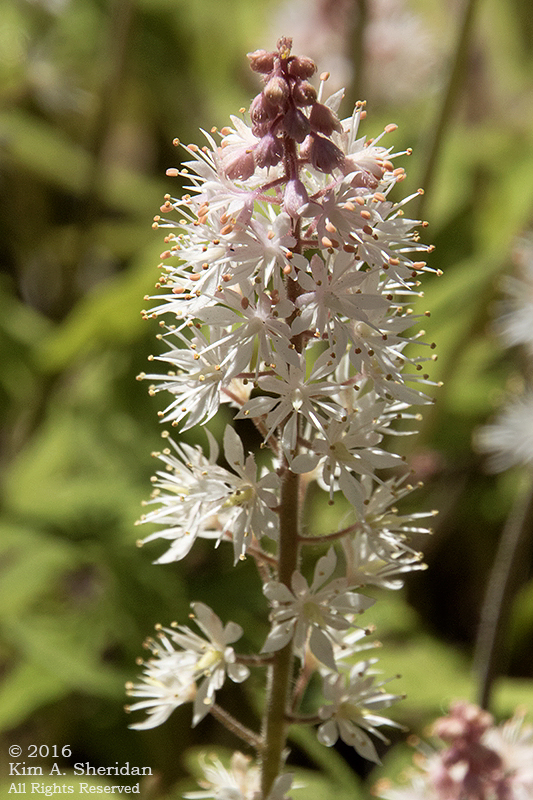
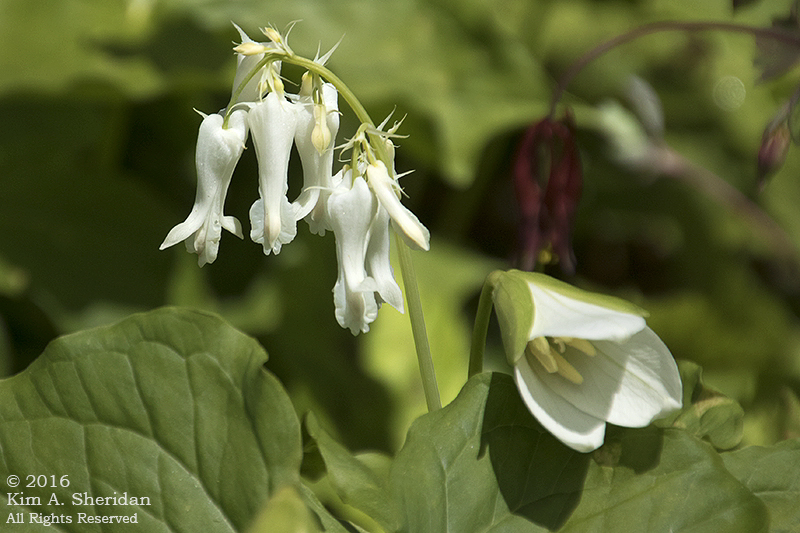
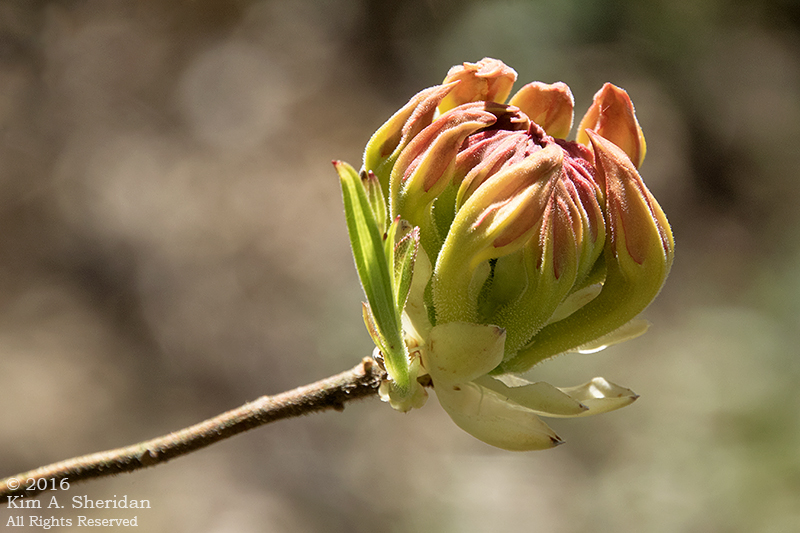
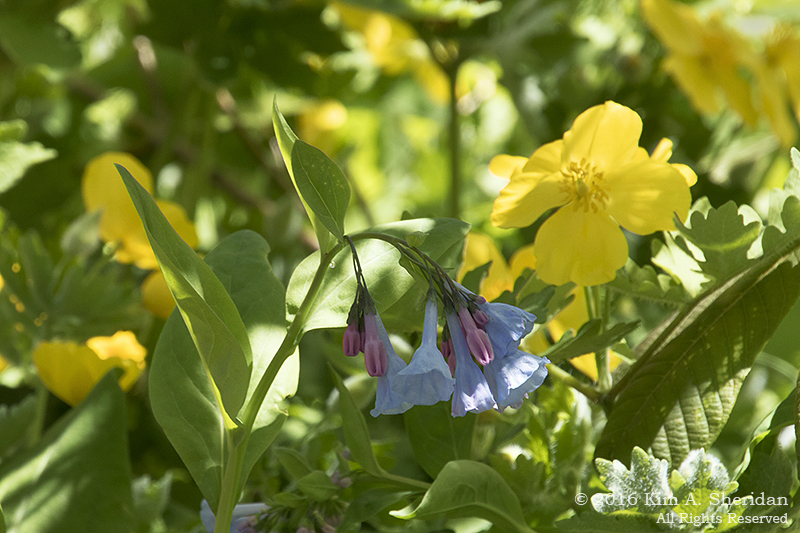
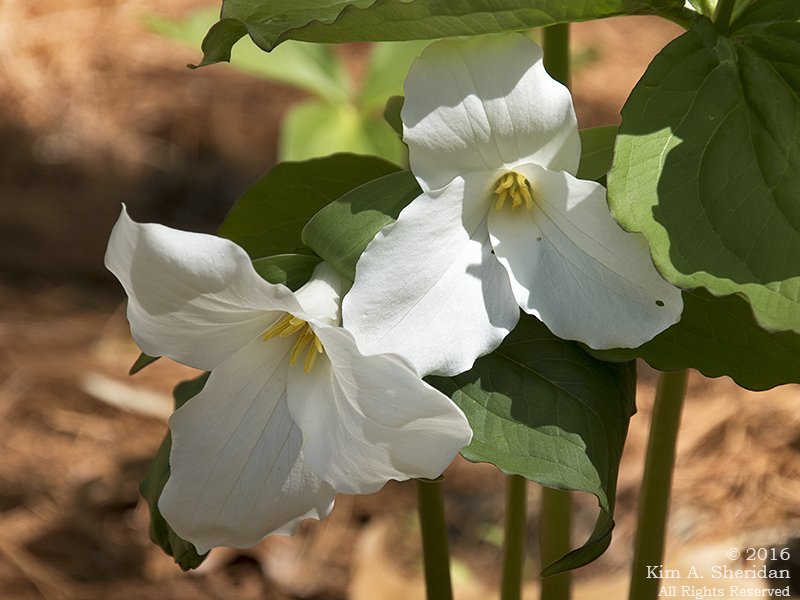
160420_DE Mt Cuba_5741acs160420_DE Mt Cuba_5758acsToday is the Wild Edge’s birthday!

Together we’re 3 years old, this little blog and I.

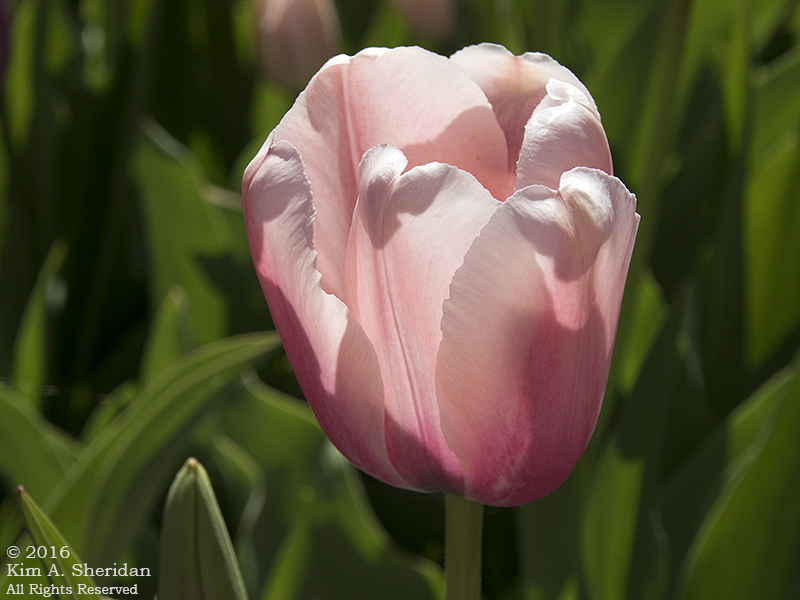
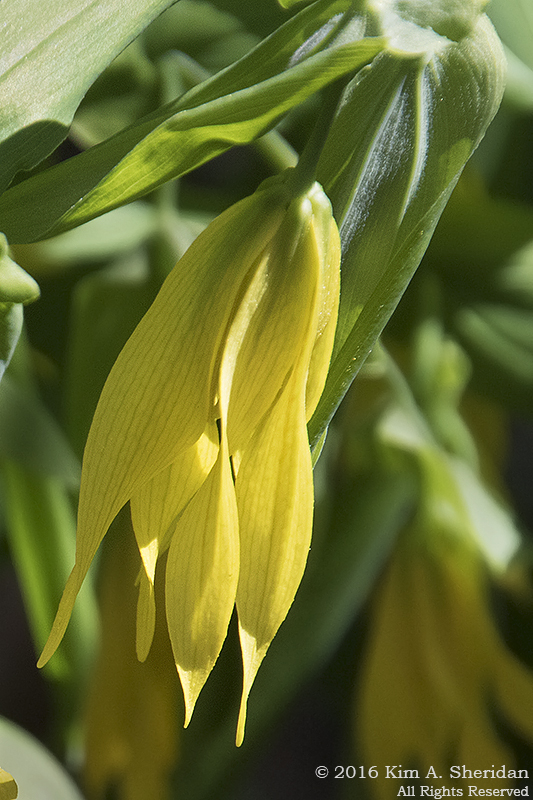
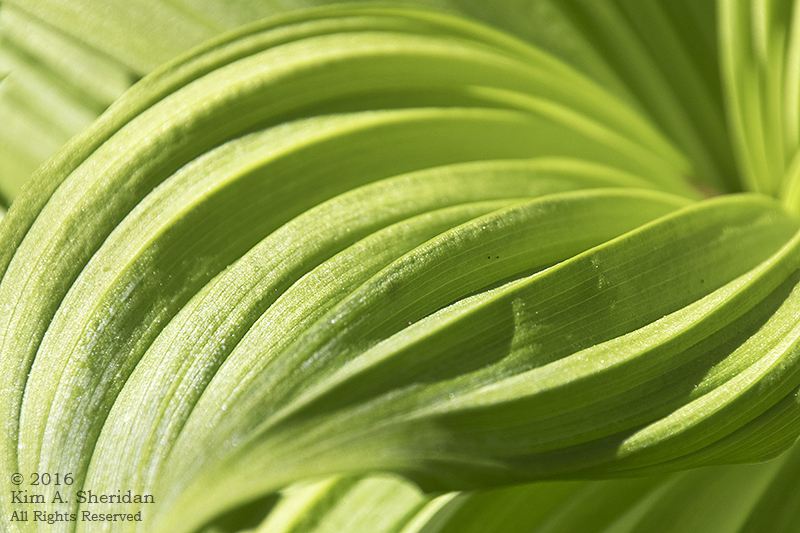
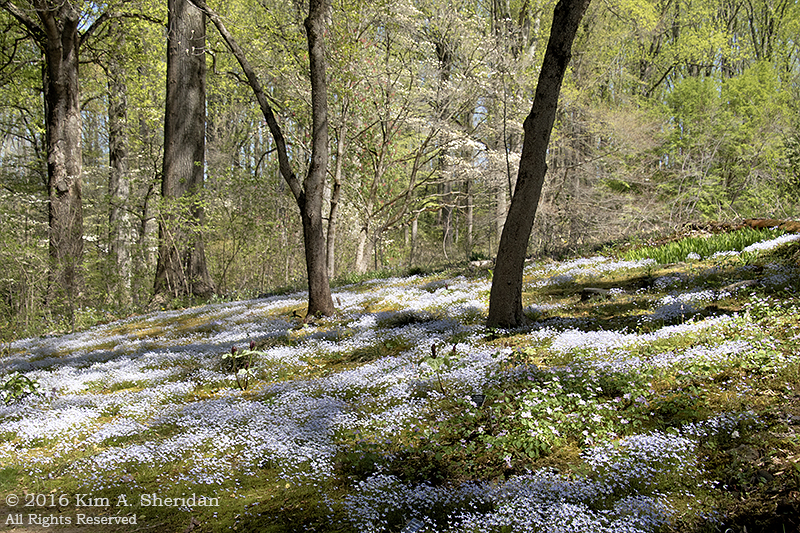
I thought I’d send myself a floral bouquet, photographically picked at Mt. Cuba Center in Delaware.

160420_DE Mt Cuba_5755acs160420_DE Mt Cuba_5867acs

160420_DE Mt Cuba_5835acs

160420_DE Mt Cuba_5850acs

160420_DE Mt Cuba_5941acs160420_DE Mt Cuba_5903acs160420_DE Mt Cuba_5935acs160420_DE Mt Cuba_5887acsOn our first birthday, I wrote an impassioned plea for readers to get outside, to appreciate and protect Nature. Slightly paraphrased, those words are no less vital today:

My hope with the Wild Edge is to reach beyond fellow photographers and nature lovers, to those who may be more at home inside. If I can pique their interest with photos, words, humor and random fun facts, maybe they’ll go outside. If they go outside, maybe they’ll fall in love with the wildness around them. If they fall in love… Well, the rest is up to them.

160420_DE Mt Cuba_5764acsSo, the Wild Edge has been running for three years now. Has it worked?

Has anyone out there been intrigued enough by something you’ve seen or read to go to a park, preserve or other natural place yourself? Do you now make a habit of it?

Do you recycle, pick up litter, support land preservation? Are you encouraging young conservationists?

Will anyone stand up for Mother Earth and her creatures?

If so, great! You have the appreciation of a grateful blog mistress. If not, keep reading the Wild Edge. Maybe something in the days and weeks to come will spark your interest and inspire you to GO OUTSIDE!